



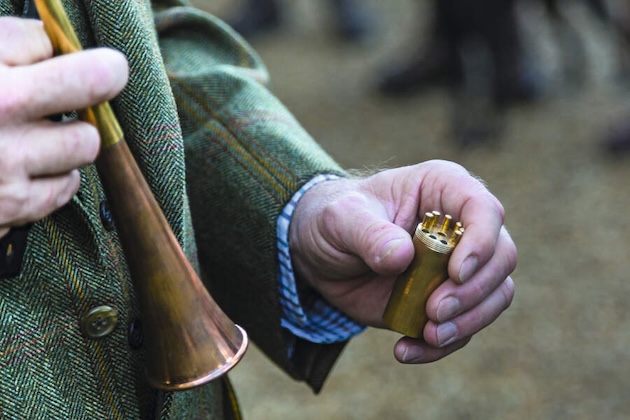
A shot of sloe gin supped from a numbered glass before rattling off in the gun bus, a selection of hallmarked pegs picked from a walnut cylinder designed to look like a cartridge, or a bespoke hip flask filled with warm brandy. The peg allocator comes in many formats, and its role is as much a shoot-day ritual as it is a way of ensuring guns’ drive positions are fair.
Drawing pegs
Matt Smith, sporting agent at Purdey, loves the moment when pegs are drawn.
“The rules talk first thing is pretty serious: behaving yourself, what you can and can’t shoot, health and safety,” he says. “Peg selection usually follows and the banter begins – who has the best first drive, are you standing next to the hotshot and all the rest of it. This really breaks the ice if it’s a group of guns who don’t know each other and is a nice preamble before booting up and setting off.” Smith has seen glass baubles at Gloucestershire’s Farmcote estate, hessian bags full of numbered snooker balls, and lots of the “traditional leather wallets with metal pins, and shot cartridge ends with numbers underneath”.
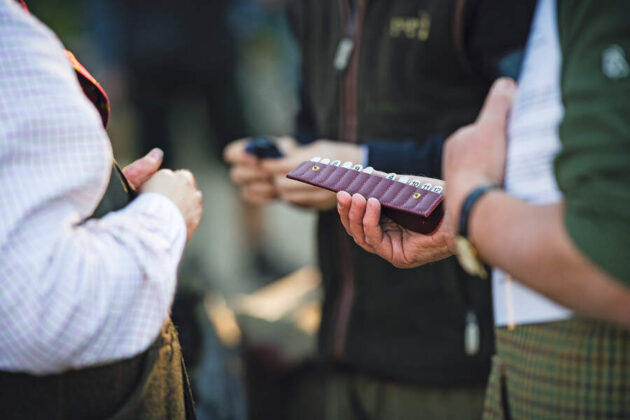
The traditional leather wallet with numbered pegs is a familiar sight on shoots
On some shoots Smith says guns give their number to their loader so they don’t have to think about where to stand on each drive. One of the charms of the sport is that every shoot does it slightly differently but the aim is always to fairly divvy up the best spots. “If you’re ‘numbering nine, moving two’, for example, you’ll move up the line by two each time,” says Edward Tennant, who is the fifth generation of his family at the helm of the 5,000-acre Innes House estate in Elgin. “This ensures everyone gets a drive or two in the middle where the shooting is usually best.”
Wonderfully extravagant
Allocating pegs became a necessity when driven shoots took over from the less formal walked-up sport that had been the norm until the early 1800s. The marriage of Queen Victoria to Prince Albert in 1840 really lit the fire. The Prince reared vast numbers of pheasants, introduced more hares and extended the Royal estate at Windsor by acquiring sporting rights over nearby Bagshot Park. By 1875 major landowners in every part of the UK were building up their shoots, and daily bags of up to 1,000 at Chatsworth, Eaton Hall and Holkham were making headline news. The Prince of Wales, later Edward VII, was a particularly keen shot, making an annual ‘progress’ around the finest estates. David Buck, owner of Steppes Hill Farm Antiques and an expert on the peg selector (or butt marker, as he and many term it), explains: “The King had neither the shape nor the temperament for the hunting field. The organised driven shoot was ideal, and its pleasures were admirably exclusive and wonderfully extravagant.”
Said extravagance also extended to the shoot’s accoutrements. An Edwardian peg selector might take the form of a sterling-silver case with fanned flat pegs or a miniature recreation of a shotgun butt containing numbered balls. A hallmarked rectangular box engraved with double As and containing six peg tubes was attributed to Edward VII’s wife Alexandra. It sold at Bonhams for more than £500 over a decade ago; it would certainly go for a lot more today. Anything with royal pedigree is sought after but Buck advises that lesser mortals’ initials are likely to be polished out before a selector enters an auction room.
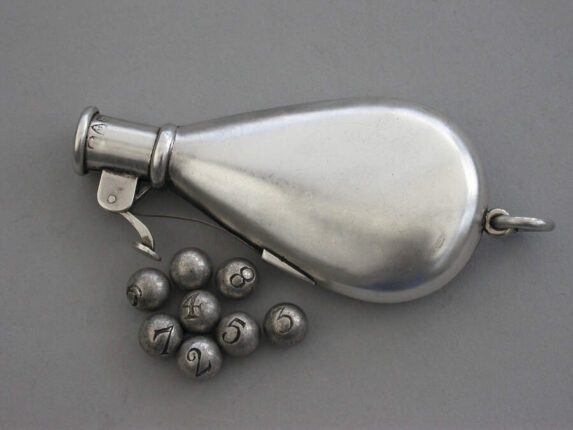
By the late 1800s top makers were producing a remarkable variety of peg selectors, including this silver shot flask filled with numbered balls
By the late 1800s exclusive makers such as Asprey, James Purdey & Sons and John Millward Banks started to produce a “fascinating variety” of peg selectors, according to antiques expert Robin Hereford. He describes Vesta-style boxes with a match striker in the base: “It was multipurpose, like a Swiss Army knife; a real sportsman’s tool.” One of Hereford’s personal favourites is a silver shot flask in the style of an early-19th century lead muzzle-loader, filled with numbered balls (shown above). “These have a propensity to roll off the hand, which makes intact examples incredibly rare,” he says, explaining that such accidents started to have a bearing on design, with cross-hatching details becoming favoured to help prevent selectors slipping out of wet hands, while less durable examples would have a shorter lifespan.
“Leather wallets were commonly used but with bone or ivory pegs instead of the resin or plastic pegs you find today,” Hereford continues. “These might have been prone to being snaffled by an enthusiastic labrador, while the leather would degrade over the decades.” He issues a note of caution: if an item contains at least 10% ivory it falls foul of CITES (Convention on International Trade in Endangered Species of Wild Fauna and Flora) regulations and is illegal to buy or sell. This makes ivory examples impossible to value for insurance purposes. Antiques expert Henry Baggott shares the same advice; he isn’t sure what CITES would make of an Asprey knife with feather-and-fur counting dials now held in a private collection and once owned by the Maharaja of Patiala, a keen shot in the early 20th century. Baggott believes the knife to have been made of tiger bone. “The fleck to the bone makes it quite unlike elephant ivory,” he reveals.
Modern selectors
Contemporary examples can be no less exciting. At Innes, Edward Tennant uses hip flasks engraved on one side with the family crest and on the other with the peg number. The flasks are filled with homemade orange brandy that provides the gun with a “warming tipple throughout the day to counteract the Scottish winter weather”. Simon Henderson, owner of The Grosvenor Hotel in Stockbridge, would applaud. He’s a fan of a sloe-gin shot glass with your peg number revealed at its base: “Thank you very much, especially in a howling gale with birds blowing past at 100 miles an hour.”
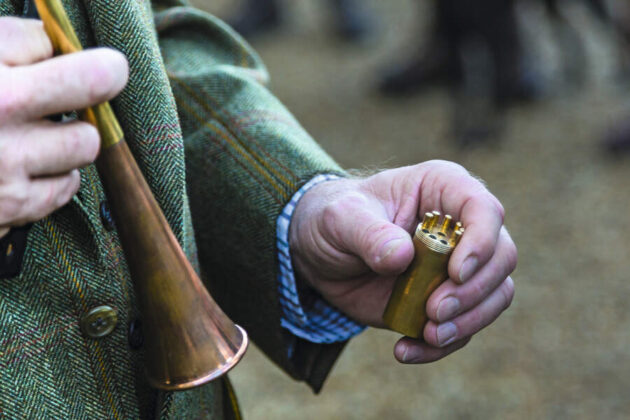
A cartridge-shaped holder in brass with individually numbered pegs
Elizabeth Roberts, estate administrator at Lees Court in Kent, says some guns have moved on from the days of sloe gin at breakfast, a bullshot for Elevenses and copious quantities of red wine at lunch. “We started sending guns and beaters out with water bottles but we realised we were creating a lot of single-use plastic so commissioned Lees Court-branded aluminium bottles. We put numbers on the bottom for those we wanted to use as peg might exercise their discretion to shuffle things around,” she adds.
Marc Brown is shoot manager at Bettws Hall where gold pin badges in the estate’s theme colours match their smart foil-embossed game cards. “They are both a functional and a fashionable item, serving an important purpose in the exciting morning draw and a quirky way to promote the estate: we often see selectors from past seasons proudly reused on gun slips, hats and jackets. In past seasons we’ve created peg-selector pens, bottles and key rings,” he says. Derek Hutchinson from Buccleuch Estates uses numbered pens to select pegs for game and simulated game days: “It provides our guests with a practical, small memento to take away at the end of their experience at Drumlanrig Castle.”
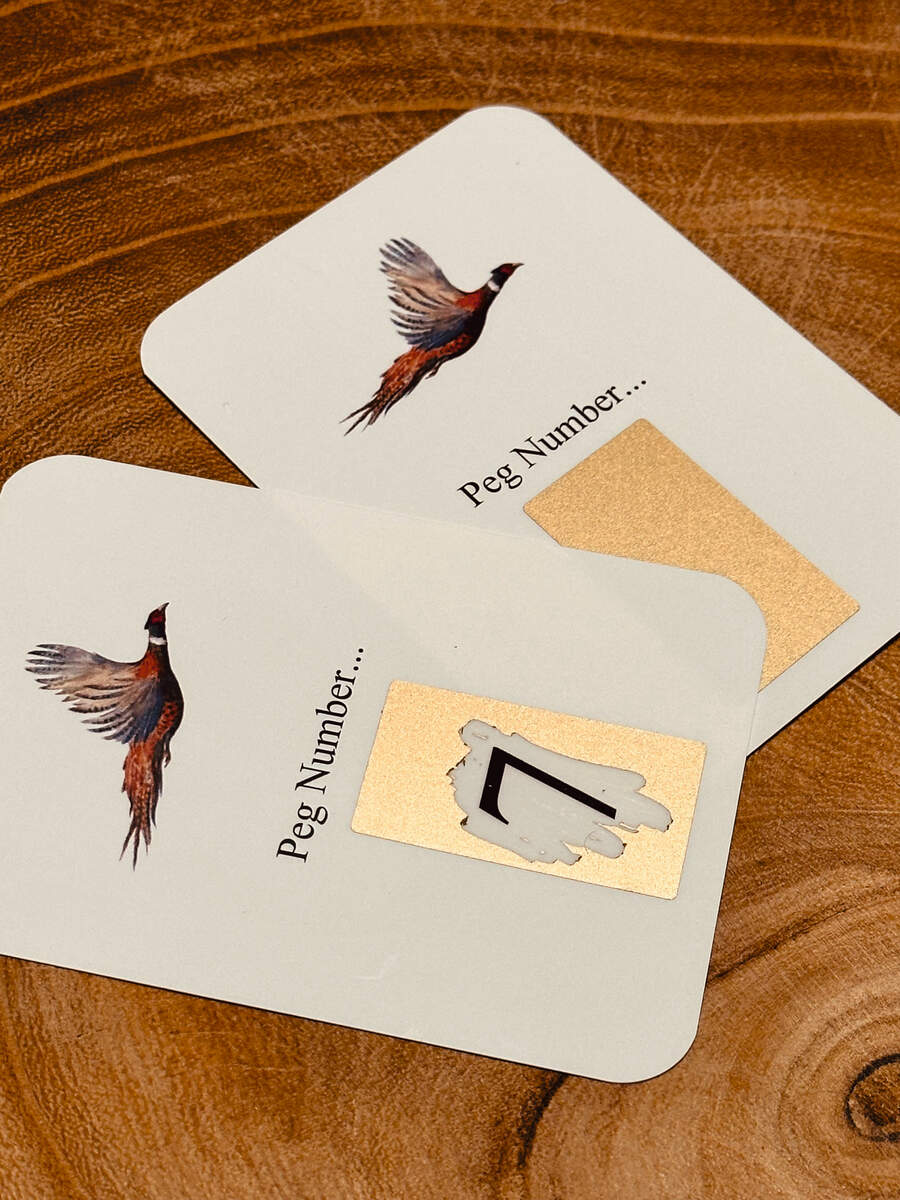
Illustrated scratch cards are a popular invention
For many shoots, peg selection is a way to focus on safety. (Read the shooting safety rules here.) At Hampshire’s Bereleigh estate numbered cards are printed with the name of every gun. Estate owner William Tyrwhitt-Drake says this is important because “if you don’t find the names till the end of the day you spend the whole shoot trying to work out who is who”. He also hands out a “proper” game card at the end of the day. “This might seem overkill but they are two completely different lists. Our morning card has a plug for the Countryside Alliance and its insurance policy, as well as a health-and-safety checklist to comply with regulations.” It’s a similar story at Foxley in Herefordshire, where James Davenport inherited his father’s numbered rules of engagement card system – and a famous yellow- and red-card system for errant guns who fall foul of the rules.
Scratch cards are an increasingly popular choice, giving a little edge to the proceedings. Annys Skilton, of Skiltons’ Bespoke Shoot Cards and Stationery, handmakes off-the-shelf and bespoke scratch cards featuring her father’s original artwork. She also creates cartridge peg draws using cartridge caps from David Morris Sporting in Hopton on the edge of the Shropshire Hills, a shoot run by her sister and brother-in-law. Both systems are widely used on pheasant, duck and simulated shoots across the UK. Skilton’s ‘peg wheels’ are also well thought of because they can be adjusted to suit the numbering of each individual shoot to give guns a clear indication of their peg on each drive: useful for those struggling to recall where exactly to place themselves on the next drive or after the hiatus of Elevenses.
Making your mark
Hayward & Stott’s silver markers topped with pheasant heads are presented in a leather wallet that can be personalised, while Fine Shooting Accessories (FSA) also has a splendid selection. Its set of 10 sterling-silver hallmarked shotguns with a number on one side of each stock is a favourite with customers. The gunmakers also stock covetable position finders, from Purdey’s smart walnut case that sits easily in a pocket to a boxed version from Holland & Holland that takes the form of shotgun cartridges or dinky replica .375 H&H cartridges in polished brass.
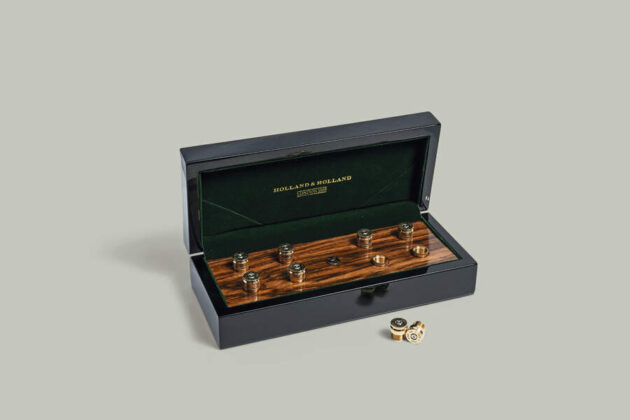
An elegant position-finder set from Holland & Holland, featuring replica brass .375 H&H cartridges that unscrew to reveal the peg number
If you’d like to recreate history, try the Pathfinder Position Finder from FSA based on an 1800s design with hand-engraved pegs fanning out from a small silver case. Francis Pearce, vice-chairman of The Gunmakers Trust uses an Asprey creation in the style of a shot cartridge with peg selectors popping out when the cap is turned.
Those unlikely to ever run their own shoot don’t have to miss out on owning a smart set of selectors. My husband has an ivorine set in a leather case given as an usher’s present. As well as coming in handy when allocating the order for a team in a clay competition, he uses it when the children are reluctantly trying to get out of the hated middle seat in a car or plane. Drinking games are many and varied. Add sloe gin to a numbered shot glass and you’ll be transported to a Yorkshire moor as an extra bonus. And if you’re ever clearing out a gun safe or a desk that once belonged to a keen shot, always have a rummage. Robin Hereford says peg selectors are so small they can be out of sight for decades, and if you find one you’ll have a potentially valuable piece of history to play with.