




Getting the best out of a .410 requires a full understanding of its strengths and limitations but the pay-off in the field is well worth the effort
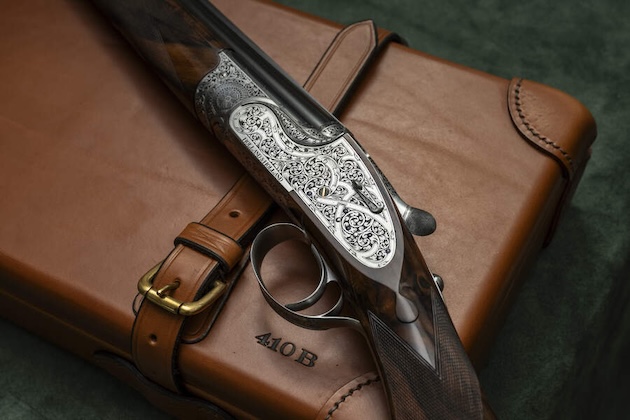
Few things are more enjoyable than a .410 driven day. The gauge encourages camaraderie and curiosity over contest. Performance may exceed expectation. Provided sensible limits are imposed on range, you may soon forget that you are using a smaller bore. A .410, like a 28-bore, can make the average more exciting. An inclination to understand the .410 may develop too: to get the best out of it requires a little extra effort. Where to begin? The .410 (sometimes mistakenly called a 36-gauge or 36-bore in Europe and South America) is measured by its bore (the internal diameter of the barrel in inches) – usually 0.410in (10.4mm, sometimes larger) – rather than its gauge. By the normal arithmetic, which is calculated by the number of pure lead balls of barrel-bore diameter required to weigh a pound, it would actually be a 67- or 68-bore. (Read our .410 reviews here.)
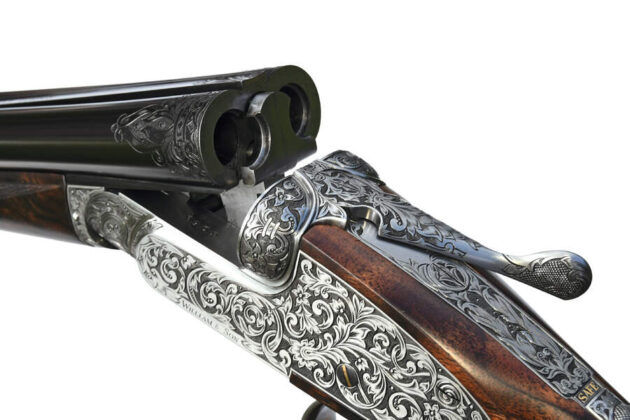
The writer lists a William & Son side-by-side as among the best .410s he has shot in recent years
A great little tool
Nomenclature apart, I get quite misty-eyed about .410s with their happy memories of youthful adventures. After brief possession of a 9mm rimfire Webley & Scott ‘Garden Gun’ to engage tin cans and cream crackers in my grandmother’s large Kent garden, I moved up to a .410 Webley & Scott bolt-action. This was the gun with which I learned to shoot properly: a great little tool for rabbits and pigeon. And, 50-plus years later, I still use these Webley .410 bolt-actions to teach young people. There are few guns better for ab initio instruction because of their soft recoil (assuming a 2½in cartridge), low frontal weight, and good stock and (not too big) grip design, although typically butts need to be cut down an inch or more and a comb raiser added.
My own early experience of .410s was surprisingly extensive. I kept swapping and trading guns. I had break-actions, including a Canadian Cooey Model 84 (which provided a test-bed for my first use of a sound moderator), and later various hammered Spanish single and doubles, and a folding Army & Navy ‘poacher’s gun’. One of my more unusual guns was a Belgian .410 walking stick with folding trigger and a malacca cane effect painted barrel with celluloid (ersatz buffalo horn) handle. I also acquired, with some pride at the time, a three-shot Mossberg .410 with an external adjustable ‘C-Lect’ collet choke. In subsequent years I bought a smart Italian side-by-side Anson & Deeley non-ejector, a Bland hammer double converted from a rifle and, much later, various Berettas and Browning over-and-unders (the latter usually built on 20-bore frames).
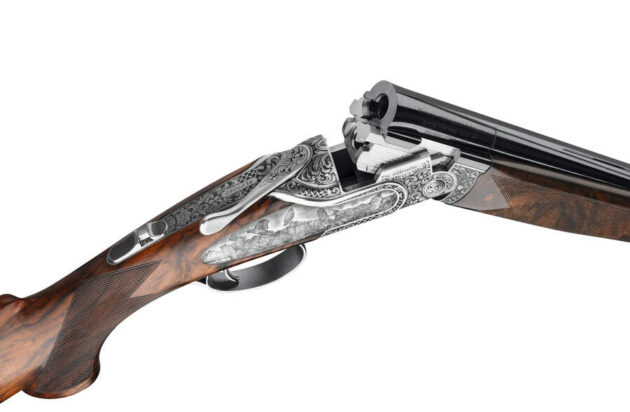
Beretta’s SL3 .410 over-and-under shotgun
Taking a broader perspective than my own collecting, the Browning B25 .410 model was first launched in 1959 together with a 28-bore. Baikal offered its famously tough IZH-18 break-action single-barrel as a .410 in 1979, and Miroku marketed a .410 in its 3700 range in the 1980s (but first promoted one in the US under the Charles Daly brand in 1963). Today Beretta and FAIR use the same small frame for their 28-bores and .410s. Webley & Scott offers (or at least offered) an excellent dedicated .410 overand- under with a steel action, which I have found to be both good value and effective in 30in 941B model form. The Yildiz overand- under .410 built on an alloy action is another ideal modern teaching tool and well priced too (but, for my money, there is still nothing better than the simple little Webley bolt gun for first-principle teaching purposes or as a farm or shoot workhorse).
London’s carriage trade continues to make wonderful top-end small-bore guns aimed at wealthy collectors and US upland hunters (on southern quail shoots a .410 or 28-bore remains de rigueur). Historically, Purdey first made a dedicated .410 sideby- side in 1928. In the 1970s it built a .410 on the Woodward over-and-under action. Holland & Holland finished its first Royal side-by-side in 1964; the first Royal overand- under appeared in 1992.
Functionally, among the best .410s that I have shot in recent years have been a William & Son side-by-side and a wonderful Purdey over-and-under built around a pair of unfinished 28in barrels found in the factory and around which a truly remarkable gun was assembled (normally the action would come first and be passed to the barrel-maker). At the other end of the scale, I am also a fan of the current Mossberg pump-action. Hushpower offers a sound-moderated version of this as well as a silenced single-barrel Yildiz. They once produced a similar gun based on the break-action Baikal, which will be familiar to many gamekeepers and pest controllers.
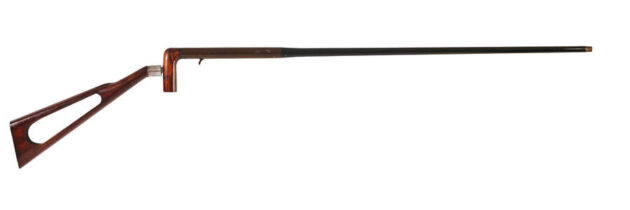
A .410 walking-stick gun with painted metal action, side safety and removable skeletal stock
sold by Bonhams in 2023
Early history of the .410
The .410 has a particularly interesting backstory. Developed in England in the 1850s and pioneered by Charles Lancaster, it evolved from early pinfire and centrefire revolver cartridges. Eley Brothers first listed .410 shot cartridges in 1857, and by the 1870s the round was firmly established in its catalogues, offered both as empty cases and loaded 2in shells. Winchester also introduced a (slightly bottle-necked) 44-40 shot cartridge in the 1870s, which became popular and inspired the 2in Hopkins & Allen 44-40 XL – a distinct shotshell – and dedicated weapons. Today the .410 remains the smallest commonly available shotgun bore, as 9mm Flobert (rimfire) ammunition has become increasingly hard to source. Eley introduced the 21/2in ‘Fourlong’ around 1912 (and continues to make 2½in cartridges under that name). The 3in magnum was introduced in 1927 by the Midland Gun Company, with the ammunition supplied by the newly created Imperial Chemical Industries. Initially, this load carried a ¾oz payload, but the long shot column did not create good patterns, so the standard 3in load became 11/16oz. While the 3in cartridge was a British introduction, Winchester popularised it, improved the ballistics and offered a now highly regarded small pumpaction for it – the Model 42 – in 1933.
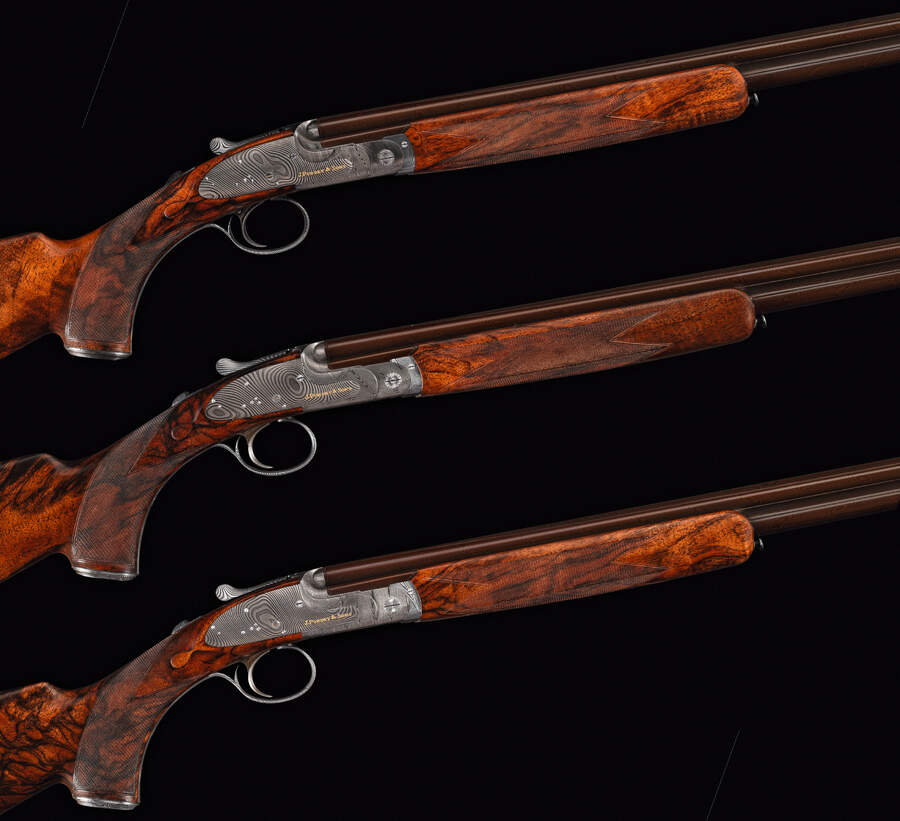
A trio of Purdey .410-bore sidelock over-and-unders completed in the gunmaker’s damascus finish
Harrington & Richardson (H&R) sold .410s in the US from 1911, with a dedicated model appearing in 1915 (the H&R 1915). It was chambered for a 2½in cartridge. These were intended for small game and pest control but in short-barrelled pistol form (like the H&R Handy-Gun) for self-defence ‘at home, in the car or at the office’. Such firearms were prohibited under 1934 US legislation but a legal loophole was to rifle the barrels and chamber them as a .45- .410 pistol (such as the modern Thompson/ Center Contender .45 Colt/.410). Revolvers in .410 such as the Taurus Judge (which also chambers .45 Long Colt) still have a significant following in the US, though remain illegal here. Double-barrelled, side-by-side, .410 pistols were seen on both sides of the Atlantic, and most of those sold in Britain were made in Belgium (like many less expensive .410s of old). Surprisingly, these may still be sold here under tight Section 5 restriction. Under Section 4 of the Firearms (Amendment) Act 1997, .410 shot pistols are technically prohibited as Section 5 weapons but they carry an unusual and specific exemption under Section 4 of the 1997 Act. They can be held on a firearms certificate for humane despatch or pest control on land where the holder has permission to shoot. They cannot be owned for target shooting.
Cartridges, choke and pellet size
Shells of .410 size are commonly available in three case lengths: 2in (51mm), 2½in (64mm) and 3in (76mm), mainly with plastic wads (though some fibre loads are still available). There is no commonly available 23/4in .410 (Ithaca briefly experimented with other intermediate lengths such as 2⅜in and 2⅞in in the early 20th century for better patterning but abandoned them). Standard lead loads for .410 today would be: 2in – 3/10oz to ⅜oz of shot (8.5g-10.5g); 2½in – typically around ½oz (14g); and 3in – 11/16oz to ¾oz (19g-21g). Subsonic loads are produced in 2in, 2½in and 3in lengths.
The above is in regard to lead birdshot. Special tungsten loads now allow a .410 to be stuffed with a 13/16oz payload (for turkey shooting). These have boosted .410 performance and may allow for dropping a pellet size while retaining good down-range energy. Three-inch .410s may also fire 1/5oz or ¼oz rifled slugs and buckshot (three or four pellets per case). Steel shot, however, is difficult to adapt to .410 use: it is much lighter than lead and hard to get enough pellets on quarry for ethical shooting. Bismuth and tungsten are much better options and ones that may ensure the gauge’s survival. Federal, nevertheless, offers Upland Steel loaded with 1⅜oz of No 6 shot.
Homeloading has increasing attraction for .410 users because the selection of cartridges off-the-shelf may be limited, especially as far as non-lead options are concerned, and there is a new enthusiasm for experimentation with the gauge. .410s often have lower velocities than expected but higher pressures due to their smaller bore-to-volume ratio (resulting in a longer shot column). For a 3in .410 13,500psi would be typical; around 11,500psi for a standard 12-bore. Caution is always advised with .410s, though, because of higher pressures. Take advice. Bore size is an issue. Tim Woodhouse, who has much experimented with .410s, noted to me recently: “Wadding effectiveness and type are important to prevent gas blow-by with larger .410 borings. Either plastic cup wads or genuine white wool felt; ordinary fibre is rubbish and can give rise to dangerous shot balling.”
What about pellet size? No 6 shot is the best all-rounder for game. You can go to No 5 for pigeon and rabbit. For woodcock, snipe and most clays No 7½ is ideal. Skeet shots may go smaller and opt for No 9 shot. For sporting clays 7½ or 8 is the answer. Choke wise, the .410 has a narrow base bore, so the constriction measurements are generally smaller than those of larger gauges. In a .410 improved cylinder might be 4 or 5 thou constriction or slightly more, 1/2-choke between 10 and 12 thou and full choke between 15 and 25 thou. On measurement, traditional .410s may often be overchoked by manufacturers to compensate for a sparse pattern (but this can lead to pellet deformation and longer shot strings). With the advent of steel, 10 thou would be a sensible maximum: tighter constrictions may carry an enhanced risk of barrel bulging with steel shot.
Can you overbore a .410? Theoretically yes. Some manufacturers such as Perazzi go for a slightly wider bore (in this case .413in), some Investarm folding .410s are .419 and one well-known .410 enthusiast went to .425 but it is something that must be engineered into a gun because of barrel wall safety issues. It is notable, meantime, that .410 barrel adapters work quite well and effectively push a .410 payload through a much larger 12-bore barrel fairly efficiently (but the .410 shot column and wad travel out of the muzzle without actually touching the main barrel bore).
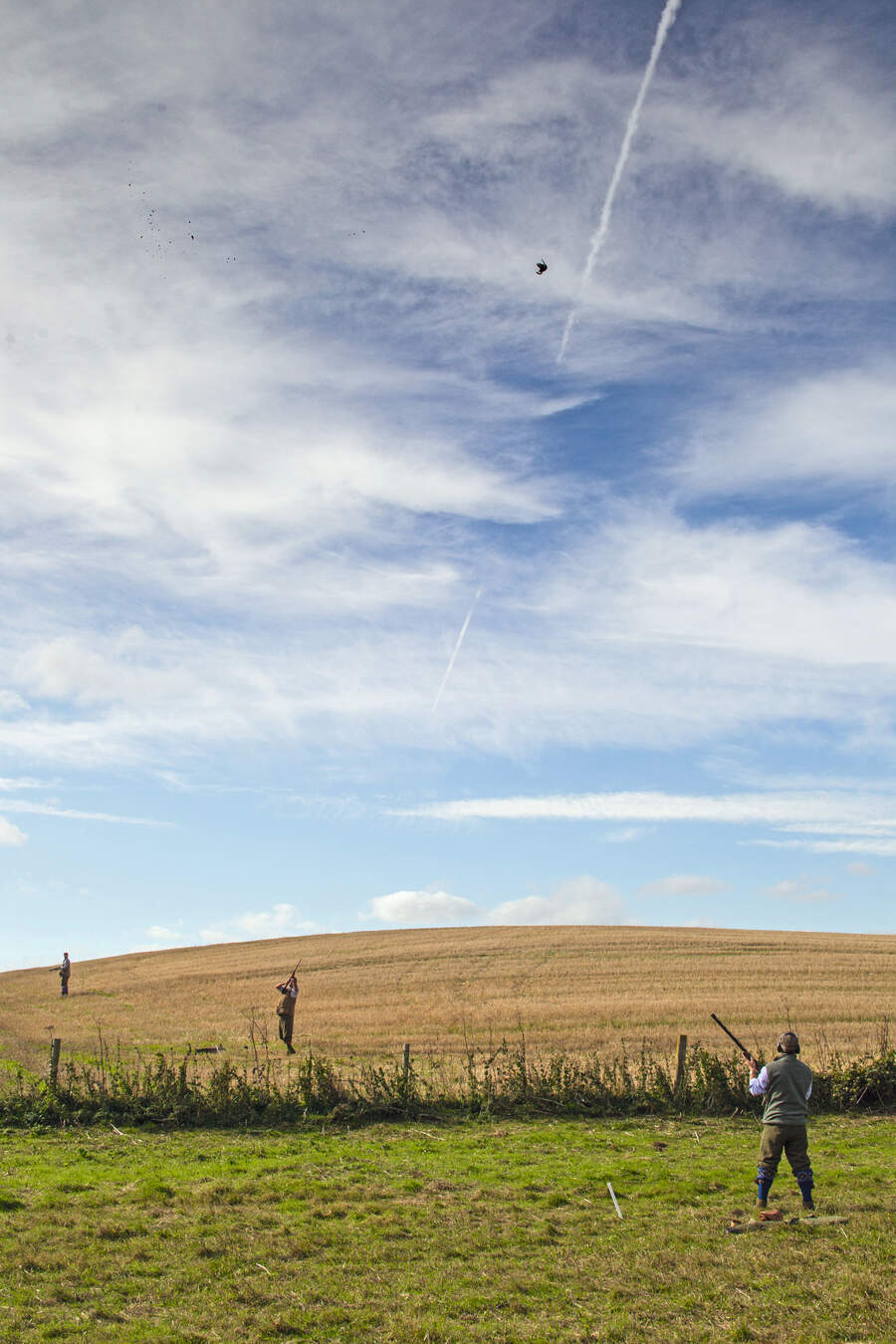
A .410 typically requires extra control and more muscular effort to shoot well
Using the .410
When it comes to shooting with a .410 they typically need extra control and, surprisingly, more not less muscular effort. They move quickly and may rush to a stop. It is easy to over-swing. Both front arm and good upper body movement (rotation/arching) are important. You need to shoot as a locked-up unit, moving through the line with precision and both hands operating in unison. Following through is vital. When teaching youngsters, make sure they start with a straight back, weight on the front foot and head well down (also check their eye dominance). A .410 is not a forgiving gun to use. Imposing a 35-yard range limit is sensible because of the lack of pattern density. Problems are amplified with poor stock fit and the poor trigger-pulls from which cheaper guns often suffer. Very light guns are more difficult to use consistently than mid-weight ones. Misses above and in front are common. Many feel, sometimes erroneously, that they need to see more lead with a .410. It is extremely easy to accidentally over-swing and stop too. You must also keep your head down and follow through. This needs to be emphasised, especially to young shots and, as ever, to keep vision glued on the bird and nothing but the bird.
Barrels of 28in and 30in are ideal lengths for modern .410 guns; 32in guns can be a handicap too in inexperienced hands but once mastered may be advantageous. In this bore my preference remains a 30in gun weighing around or just over 6lb – heavy by traditional standards. Light .410s (less than 5½lb) can be hard to control consistently, especially on driven or crossing birds. Skeet shots using 12-bores tubed down to .410 confirm heavy is generally better when consistency is the primary goal. Light guns with smaller shot payloads punish sloppy technique far more than a 12- or 20-bore. The gun can whip around wand-like if you’re not a little more deliberate than with a larger bore. Checking the swing is all too easy. To shoot a .410 well, you have to power it through the bird. The front arm in particular must do its job to control the muzzles and you must keep moving smoothly.
The .410 is a precision tool, not an accommodating one. It exaggerates faults in technique but it offers potentially enormous fun once understood. Whatever gun you choose (and I would normally advise a 28in or 30in over-and-under for all-round use) check trigger-pulls, and take it to the plates to test pattern and stock fit. Be warned, though: .410s are seriously addictive.
Image credits: Michael Yardley, Beretta, Bonhams, Purdey, Holland & Holland, Charles Sainsbury-Place
Be confident that you are always in the know and subscribe to The Field. Currently £5 for the first three issues.