



Whether surveying grouse on the moor, sitting on the peg or lying
quietly on the riverbank, a hardy and handsome Hungarian
vizsla is worth its weight in gold.
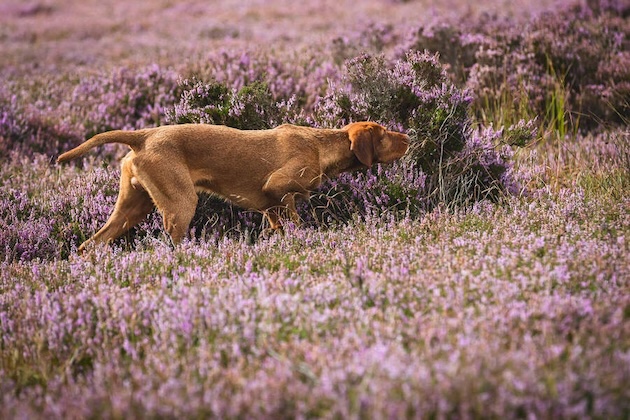
From the ninth century nomadic Magyar tribes roamed the Asian steppes, eventually settling in the Carpathian Basin – known today as Hungary. They were accompanied by sleek, medium-sized hunting dogs the colour of the cereal crops that covered the great plains. Once settled, the nobles and aristocrats continued the development of their family hunting dogs, keeping the bloodline pure and producing an efficient pointer retriever for fur and feather. By the 13th century a unique, rusty-gold companion field dog with a gentle mouth was established, adept at hunting game and wildfowl. The same breed still exists today: the Magyar pointer, the Hungarian pointer or, as it is more commonly called, the Hungarian vizsla.
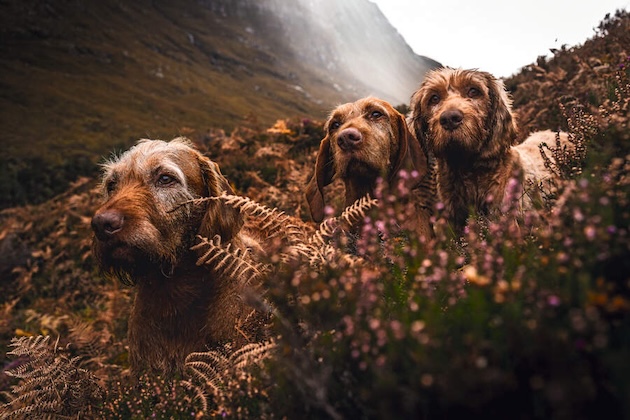
Smooth-coated or wirehaired, Hungarian vizslas are a steady asset on the moor. Photograph by Sarah Farnsworth.
Origin of vizsla
Early Hungarian documents suggest the word ‘vizsla’ comes from the oldest Hungarian language and means ‘searching or pointing dog’. The Hungarian Vizsla Club, founded in 1968, is the oldest of the recognised Royal Kennel Club (RKC) breed clubs dedicated to the vizsla and, together with the Hungarian Vizsla Society formed in 1972, works to ‘promote the health, quality and welfare’ of the breed. Following the two world wars, when many dogs were destroyed to prevent them from falling into enemy hands, numbers in the early decades of the 20th century were dangerously low. However, dedicated breeders smuggled stock out of Hungary to western Europe and the US, restoring the population from a minimal genetic foundation.
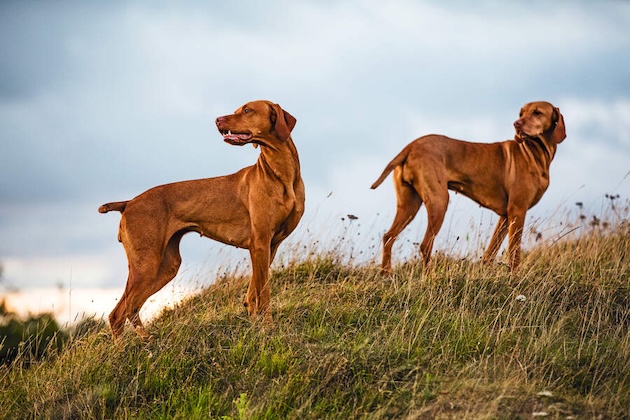
Known for their hunting ability, steadiness and stamina, vizslas are growing ever more popular in the field
Zsa Zsa Gabor
Readers of a certain age may remember the Hungarian-American socialite and actress Zsa Zsa Gabor, who is credited with popularising the breed across the pond in the early 1960s. Vizslas became well established, their hunting ability, affectionate nature, lively personality and attractive russet-gold coat matching the glamour and Hungarian heritage associated with Gabor herself. The American Kennel Club recognised the vizsla in 1960 and registrations number 2,500 annually. Admission by the RKC occurred earlier, in 1953, and registrations of 4,500 a year reflect their growing popularity.
Roy Bebbington has owned Hungarian vizslas for more than 30 years and wrote the first published book on the wirehaired vizsla, A Dog for All Reasons, in 2010. “There were only about 40 vizslas in the country when I acquired my first,” he tells me from his North Yorkshire home where he uses the dogs for falconry, walked-up shooting and grouse counts. “I worked three dogs together for the March count and again in July.” This twice-yearly practice of surveying the health, breeding success and population of red grouse is essential for assessing sustainable shooting levels, and the vizslas play a crucial part. Along with pointers, setters and other hunt, point and retrieve breeds (HPRs), they have proved to be a steady asset. Bebbington works wirehaired vizslas, which are a separate breed from the smoothcoated Hungarian vizslas but both come under the HPR classification.
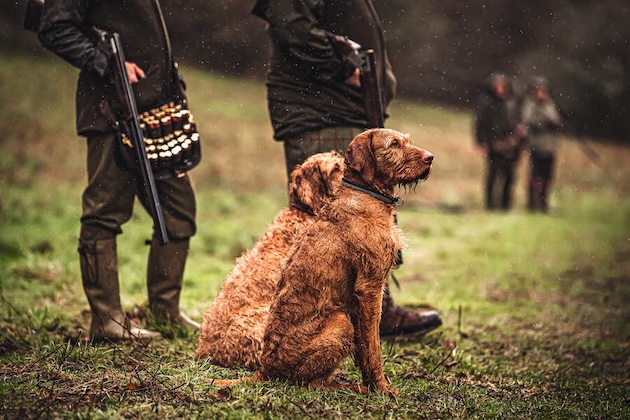
Bright and biddable, these dogs make versatile shooting companions
Wirehaired vizsla
The wirehaired was developed in the 1930s from mating a smooth-coated vizsla to a liver-coloured German wirehaired pointer to produce a dog combining the russet gold of the vizsla with a slightly more substantial frame and thicker coat better suited to cold weather. The RKC breed standard states: ‘The wire coat on the neck and body is harsh and close fitting, up to 4cm long, with an undercoat, which is normally heavier in winter.’ Colour is described as ‘golden sand to russet’.
Another regular visitor to the grouse moor is James Reavil from Kent, the field trial secretary of the Hungarian Vizsla Society and a full-time gundog trainer. He has owned vizslas for more than a decade. “I organise working tests, spring pointing tests, field trials and two trials on grouse,” he explains. He confirmed the wires are a totally separate breed from the smooth-coated. “The wire coat does vary. It can be wiry, curly or smooth but harsh wire is preferred. Regarding working, there is a fair split between wire and smooth-haired, too,” Reavil observes. Writing in The Ultimate Dog Book, David Taylor defines the Hungarian vizsla as ‘an extremely active dog with a gentle, intelligent, obedient and very affectionate character’, adding that it is ‘easily trained and has great reserves of stamina’. These traits were the reason Sam Carlisle chose a vizsla. He required a dog for duck flighting and to shoot over on the family farm set within 1,200 acres of attractive Suffolk countryside, including the award-winning Wyken Vineyards. “I also wanted a dog to fit in with a young family, and a vizsla ticked all the right boxes. He is a delight with the children,” he states. “I’d grown up with labradors but Merlin, who is now five, was easy to train as my first dog. He’s biddable, will sit at the peg, is good in water, joins me deerstalking and even locates truffles,” Carlisle confides. “We are proud to have English partridge on the shoot and it is an advantage to have Merlin point these to indicate numbers. He is equally happy to lie quietly on the riverbank when I fish for trout,” he adds.
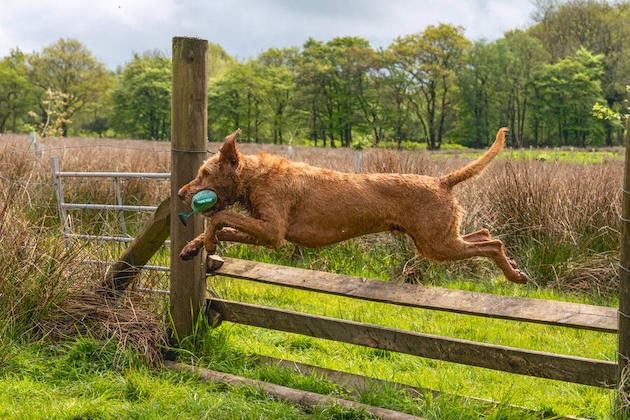
A retrieve in progress during the Hungarian Wirehaired Vizsla Association’s working test
Velcro dogs?
The derogatory term ‘velcro dogs’ is sometimes used due to vizslas’ intense attachment to their owners but Bebbington disputes this. “They are not ankle huggers,” he stresses, and is a great believer that all have inherent ability: “They require less discipline than Germanic breeds and need more freedom to let their capabilities come out.” Stating they are the ideal dog to shoot over, he finds little difference between the smooth and wirehaired. Because they inherit a strong affinity to water from their hunting heritage, most vizslas are also capable swimmers. The smooth-coated may lack the advantage of the undercoat enjoyed by the wirehaired but their ‘greasy’ coat helps.
Award-winning dog and country-life photographer Joyce Holland-Gladwish has years of experience watching all breeds of gundog on training days. She owns two German pointers but is determined her next dog will be a vizsla. “I find them lovely, steady working dogs,” she says. “You can divide working gundogs into two categories: ‘princesses’ who dislike adverse weather conditions and ‘working machines’. The vizsla is definitely the latter,” she confirms.
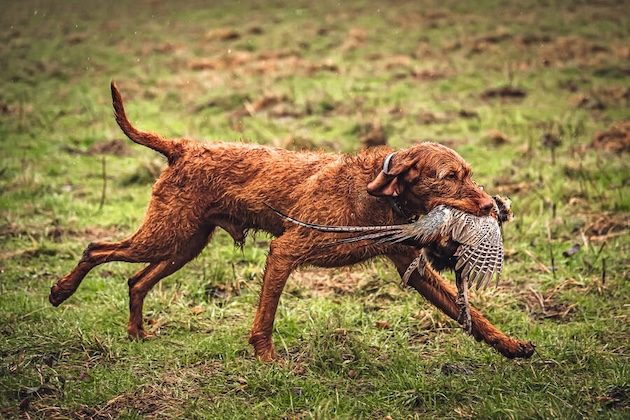
Vizslas are efficient game finders, making them a boon to any picking-up team
Shoot asset
Gamekeeper Lester Thirtle agrees the breed is a great asset to a shoot. When a keeper in Hampshire, he had smooth and wirehairs working. “I had a picker-up who worked three, all efficient game finders. I also had a picker-up with a wirehair called Nellie. She was versatile as a peg dog or retriever and always found the hardest birds,” he reveals. Another whose vizslas were admired on a shoot is owner Shirley Mattravers from north Bristol. She recounts the time she was invited by the keeper to pick up on a small private day: “I had three smooth-coated vizslas working but at the end of the day a gun confided to me that his father-inlaw, also shooting, hated my dogs. Shocked, I asked the reason. Apparently the gentleman owned a vizsla but had been told they were untrainable. After watching my dogs work so efficiently in the field, he realised he had been misinformed.”
Mattravers is field trial secretary of the Hungarian Vizsla Club and has owned the breed for over 15 years. “When I first started trialling it was thought the vizsla was not a hard enough runner but I’ve proved them wrong by producing three field trial champions,” she says. She agrees that if disciplined too much they just “pack up”. “We are lucky to be able to train our vizslas on the North York Moors. At the beginning of April we made up a party where our dogs are able to run, point and flush, similar to grouse counting but paying for the privilege.”
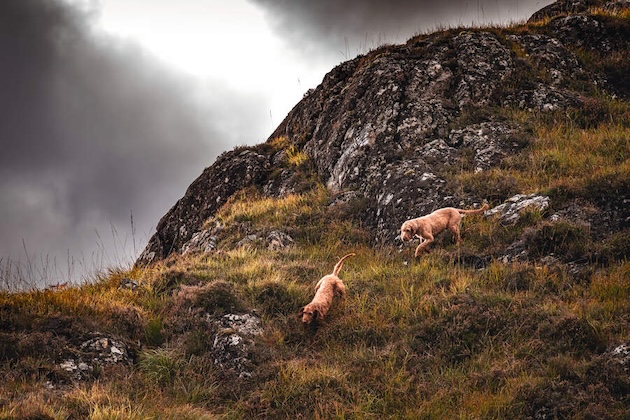
The wirehaired vizsla’s dense, wiry coat helps protect it from the elements
They were joined by John Cavana to raise funds for Morgan House in Teesside, operated by Healthier Heroes and providing accommodation, support and therapy for veterans’ recovery and reintegration. Cavana also collects excess game to turn into meals for veterans. “Over two weekends we raised more than £3,000 for the Army Benevolent Fund,” Mattravers informs me.
Before the muzzle-loader and the term ‘gundog’, game was caught using hounds, nets and birds of prey. A 14th-century Gothic panel shows a Magyar hunter, a falcon and a vizsla, demonstrating the breed was used for falconry in this period. The term ‘falconry’ is now generally applied to the use of trained birds of prey to catch game but language purists may disagree. A falconer flies falcons but an austringer flies hawks. Whatever the raptor, vizslas are valued for their instinctual teamwork with bird and handler.
‘Falconry is the most natural sport. A three-way partnership of man, hawk and pointing dog,’ wrote Bebbington, who has worked vizslas with goshawks for decades. “Training is the same as for a gundog but there is no retrieve,” he explains. I asked him how he saw the future of the vizsla, particularly in the competitive world of field trials. “They’re up there,” he replied. May I translate this succinct reply as plain-speaking Yorkshire to mean 24-carat gold.
Sign up to our monthly newsletter The Field Guide for all things country-related. Dogs, shooting, fly-fishing, wildfowling, deer stalking and more.
Photography: Sarah Farnsworth, Janet Ledner, Roy Bebbington, Getty.