



Famous for building ‘best guns only’, Boss has had a remarkable impact on British gunmaking. This beautiful bar-action sidelock exemplifies the firm’s approach, says Michael Yardley
Boss & Co 1909 side-by-side

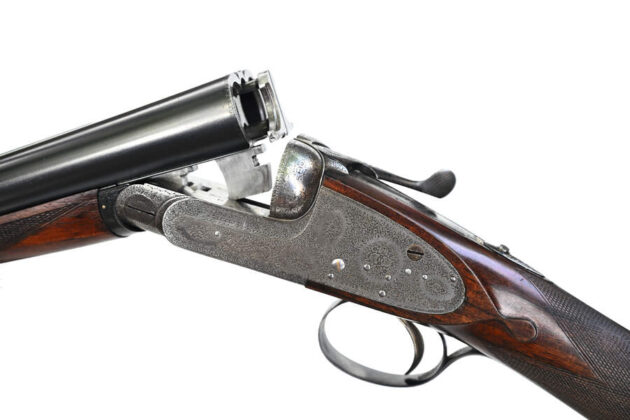
This month’s test explores a classic Boss & Co single-trigger sidelock side-by-side shotgun made in 1909. It is 30in barrelled with a concave game rib, proofed for 2½in (65mm) cartridges and weighs 6lb 10½oz. This is the third gun of a trio and has been restocked at 15in with a straight-hand butt by an ex-Purdey craftsman and reblacked by another. It remains the current owner’s favoured game gun, though he uses modern Continental overand- unders in the field as well.
In terms of style and general form, this gun cannot be faulted. It immediately feels right. The barrel weight is perfect. London barrels of this era were struck up so the gun would point and move effortlessly. This does. Condition-wise it is well used but unmistakably golden-age London best. The refined shapes are lovely – essentially as they evolved in the 1890s, and as they have remained both in square-bar form (as seen here) and with rounded bar as the firm also popularised. There may be some stylistic influence from the Purdey-Beesley of 1880 in the lock shapes but the gun is quite distinctly Boss mechanically speaking.
John Robertson was an outworker of unusual talent who became a partner in Boss in 1891 and eventually its owner. He perfected the hammerless breechloader design: the action cocks on the fall of the barrels (as with later Holland & Holland Royals). Interestingly, Robertson held a joint 1883 patent with Henry Holland for a barrel-cocking hammerless action: the fall of the barrels cocked the right lock on opening and the left on closing. This alternate lock ‘split cocking’ arrangement was overly complex but employed in early Holland Royals. The two men also held joint 1887 and 1888 ejector patents.
One of the unique and highly influential features of this later, post-1897 Boss design is coil-spring ejectors set in the fore-end: a layout that has inspired many modern over-and-unders. Robertson’s clever turret single trigger, patented in 1894, is also seen here (he did experiment with other systems). In the year this gun was made, 1909, Boss patented its seminal low-profile over-andunder too. This ‘best guns only’ company has had extraordinary stylistic and mechanical influence on British gunmaking.
Aesthetically the featured gun impresses greatly. Both slim and elegant with simple rounded fences, the action is beautiful and understated; there are beaded edges on the action belly and one side of the trigger-guard but there is no unnecessary adornment. The Jack Sumner rose-andscroll engraving on the eight-pin locks, trigger-guard and top-lever would be hard to better. It was introduced in the early 1890s by Sumner’s father, John, who worked with Robertson to create the signature Boss style. The pattern features tiny roses tucked inside a framework of fine foliate scrolls: the five-bouquet pattern usually identifies a Boss. Jack (John George) continued to work well into the 20th century, his tenure interrupted by service in the Royal Army Medical Corps during the First World War.
Boss has one of the longest gunmaking legacies. William Boss, apprenticed in Birmingham, came to London to work for Joseph Manton. His son Thomas worked under his father and Manton, setting up on his own in 1812, making guns for the carriage trade – including some for James Purdey. By 1851 the much-progressed company was displaying at the Great Exhibition. On Thomas’s death in 1857 his widow Amy brought in Irish gunmaker Stephen Grant to help. When Grant left in 1866 to found his own outfit, her nephews Edward and James Paddison assisted, and inherited Boss. James died in 1873; Edward ran the firm until 1891. In 1890 he offered John Robertson, already its principal outworker, a partnership, with Robertson buying a half-share in January 1891. On Edward’s death that year his remaining share passed to a nephew. Robertson bought him out in 1893 and became sole proprietor in an era of tremendous innovation and intense competition.
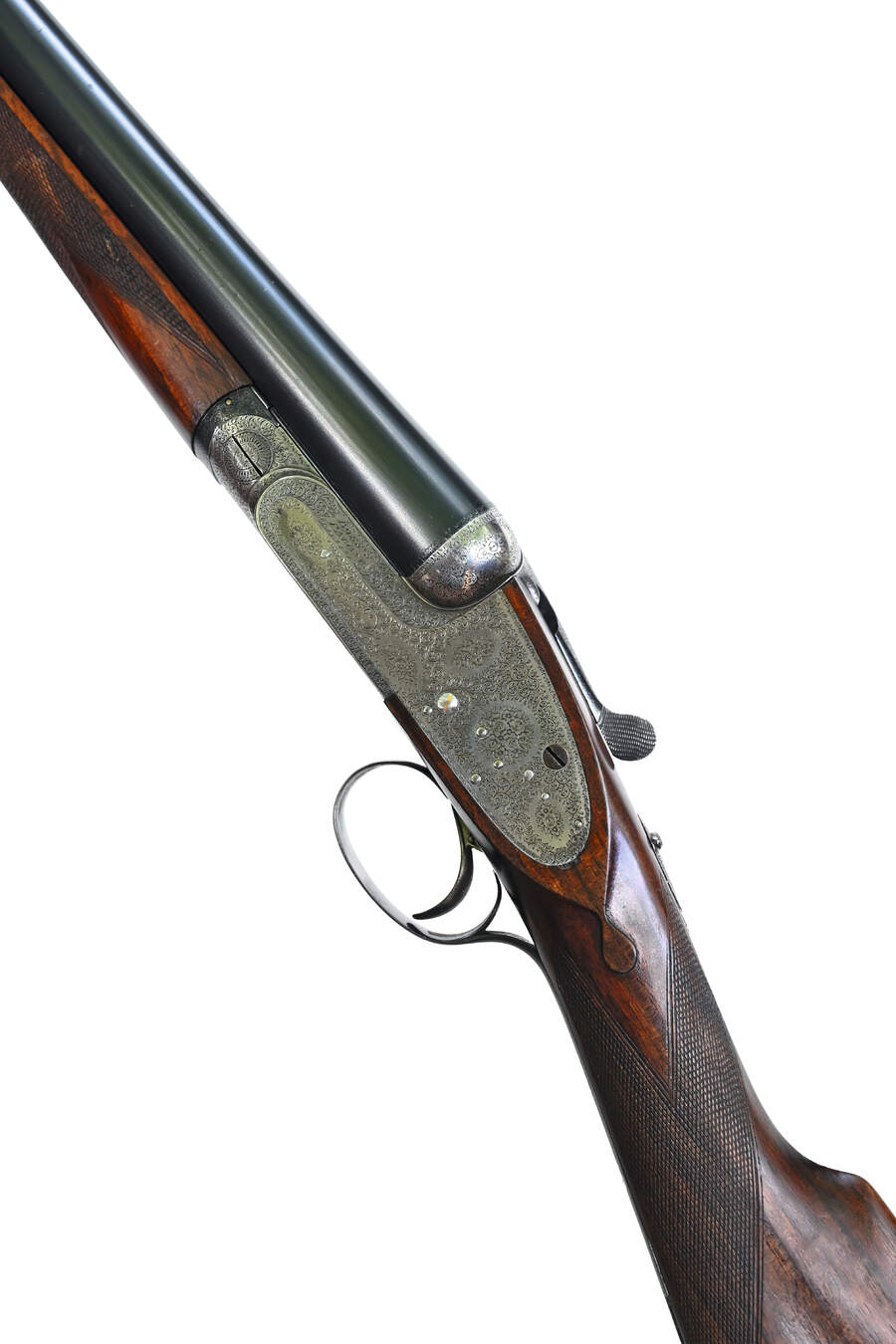
This refined veteran of the shooting field is unmistakably London best
Technical
As noted, this Boss is a bar-action sidelock of refined London design. Its atypical coil-spring ejectors are reliable, as is the innovative mechanical trigger. It uses a spring-powered, rising and rotating capstan to block the involuntary recoil pull after the first shot; only a deliberate second pull indexes it and fires the other lock. The featured specimen is 2½in chambered and still on its original 1904-25 proof. It is, however, getting close to being out of proof: one barrel’s bore is .736in and the other .738in, measured 9in from the breech – a thou of margin. Barrel wall thicknesses are 21 and 22 thou. The gun has probably been lapped and reblacked several times. Reproof is advisable. Being technically just in proof on bore diameter does not guarantee safety with today’s loads. Any vintage gun should be checked by a gunsmith with the proper gauges periodically; the decision to keep shooting it must always rest on expert advice. Lower-pressure lead and bismuth loads exist for guns deemed safe. Steel is not an option.
Shooting impressions
I know this gun and have shot it prior to detailed examination and measuring recently: handling is splendid. It has that rare quality of feeling ‘right’ in the hands immediately. The balance is good, barrel length suits and it points and moves well. Trigger function is impeccable too, and the gun is effortless and willing in use. Its mid-weight is sufficient to control recoil surprisingly well. This is the English game gun par excellence. However, its wall thickness and proof measurements after 100-plus years of use now create a bit of a conundrum: one that many lovers of vintage guns may increasingly face. Old English guns were made with relatively thin barrels (one of the reasons they handle so well) but they can get damaged – typically by rust and denting – and may fall out of proof. This must be taken seriously and acted upon dispassionately no matter how beautiful the gun.