




Often imitated but rarely bettered, Browning’s B25 Superposed is among the most influential and enduring shotgun designs in gunmaking history writes Michael Yardley
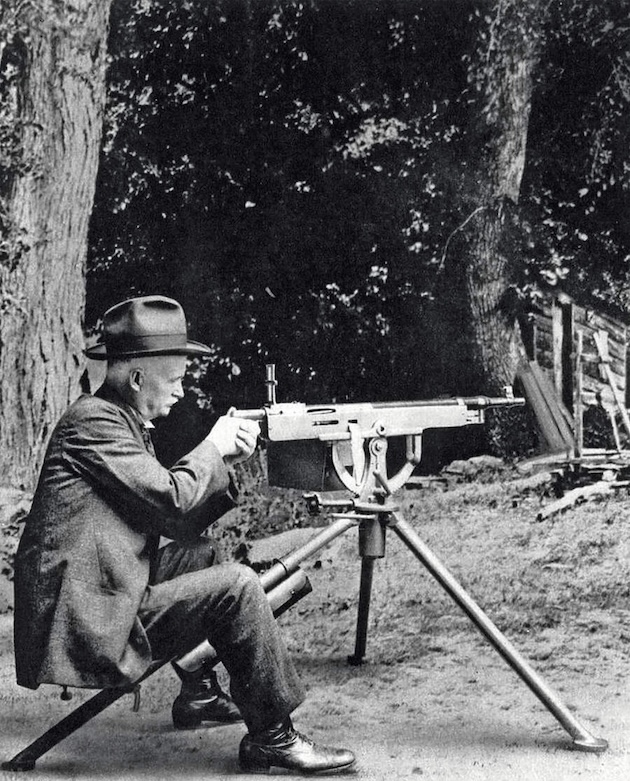
John Moses Browning with an M1895 Colt-Browning machine gun
The word ‘legendary’ is often applied promiscuously to sporting guns but is well deserved in the case of the Browning B25 Superposed, which has just celebrated its 100th birthday. The first mass-produced over-and-under, it remains a flagship for Browning with around 350,000 manufactured in Belgium and some 30 bespoke guns still made annually at the John M Browning collection workshop (‘Custom Shop’ as was) at Herstal. The B25 has inspired countless copies: more than a million guns based on it or derivative actions have now been produced in total.
Browning B25 Superposed: changing gunmaking history
The Superposed is a member of an exclusive coterie of sporting shotguns that have changed gunmaking history. Other qualifiers include the Anson & Deeley boxlock; the Purdey-Beesley and Holland & Holland sidelock side-by-sides; and the Boss (1909), Woodward (1911), Beretta 68 series and Perazzi MX8 over-and-unders. Yet more than any other, the Browning gun ensured the success and general acceptance of the over-and-under shotgun and dominated competitive shooting for decades.
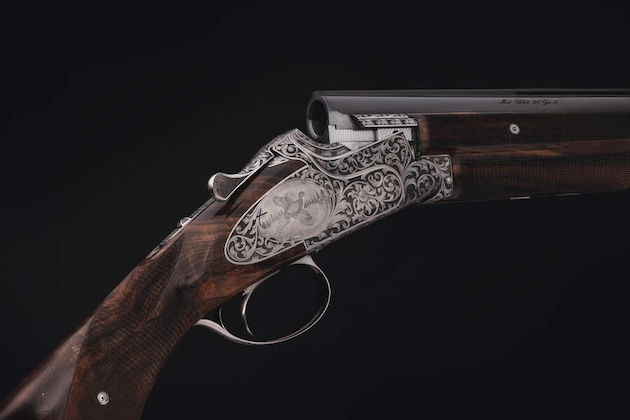
A latest-model Browning B25 Superposed over-and-under with best engraving and finish
It offered a one-piece forged frame, strong locking, selective ejection, an improved single sighting plane, simple disassembly with a fore-end that remained attached to the barrels, and various ribs and single-trigger options (as well as double triggers). Good recoil control, fast handling and ‘pointability’ were key qualities. Mechanical complexity compared with most side-by-sides was slightly greater but minimised in the elegantly simple design. Cost was also greater than a basic side-by-side (the US retail price was projected at $150 initially). Nevertheless, it was quickly adopted by competition and game shots, although not without some initial resistance in Britain. I remember aspiring to a Browning B25 in the late 1960s when they were considered the gun in clay shooting circles but still frowned upon or unwelcome on traditionally minded driven game shoots. That prejudice has passed, probably because so many have since learned to shoot with over-and-unders.
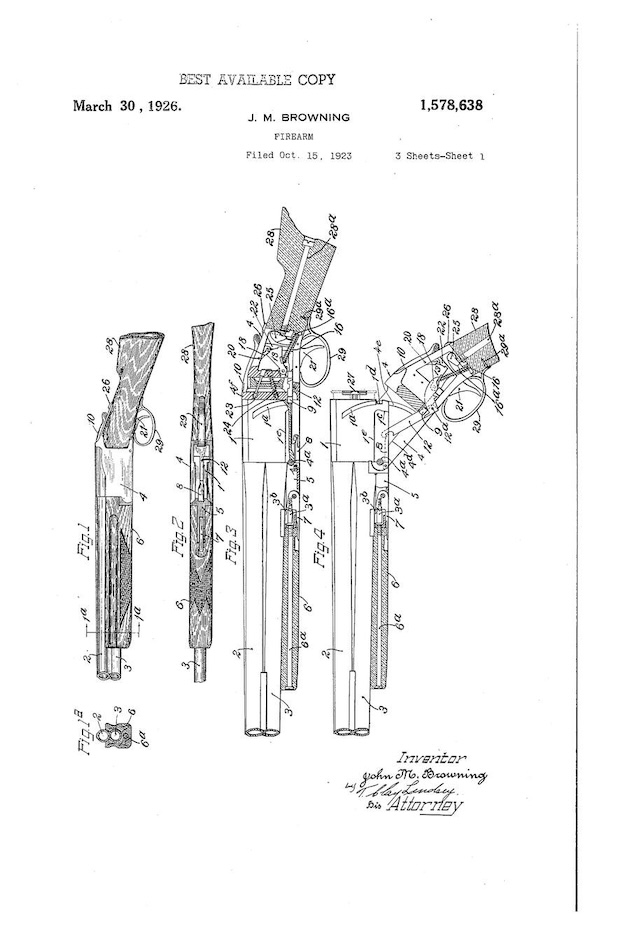
John Moses Browning’s patent for the groundbreaking B25 action
The story begins
Two remarkable men are inextricably linked to the Browning B25 Superposed story: John Moses Browning (1855-1926), the main inventor, and his long-lived son Val (1895-1994) – the man who completed the Superposed project, developing it and the Browning Company. John Moses, a Mormon, was the son of a polygamously married Utah gunsmith with 22 children (John Moses himself had 10 with a single wife). The Superposed, developed in the 1920s, was arguably his penultimate great invention. He died in Belgium supervising it and a new pistol project that would become the 9mm Hi-Power (HP) service pistol. He had opined to Val circa 1920 [in a private letter quoted by Browning historian Ned Schwing]: ‘I think there is a market for a reasonably priced over-and-under gun that will be one of the last shotguns to be legislated out of business.’
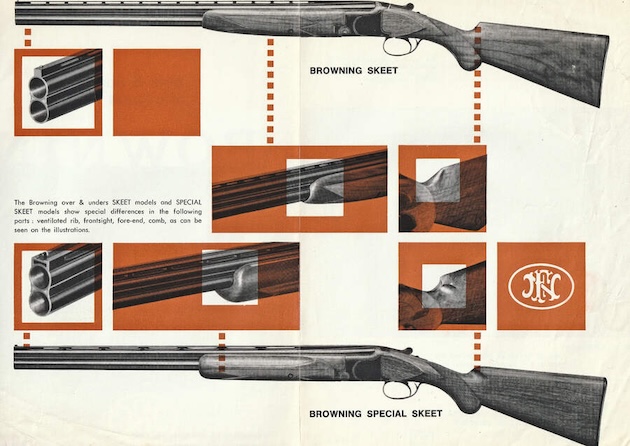
An advertisement from Fabrique Nationale promoting the Browning B25 Skeet and Special Skeet over-and under shotguns
Before the B25 and HP, his inventive genius had produced – among many classic firearms – the Winchester 1886 and 1894 lever-action rifles, the 1897 pump action, the Auto-5 semi-automatic shotgun (patent 1900 with 2.7 million sold), the Colt 1911, the FN Model 1910 pistol (as used by Gavrilo Princip in the 1914 assassination of Archduke Franz Ferdinand, sparking the First World War), the Browning automatic rifle or BAR (patent 1917), the .30-calibre Browning M1919 machine gun and the .50-calibre machine gun (patent 1921) as fitted to Spitfires and, like the M1919, still deployed. Browning took out more than 120 patents, many fundamental to modern firearms design. Hard-working and self-effacing, he often sold or licensed his designs to other firms until an enduring alliance developed with Fabrique Nationale (FN) at Herstal near Liege.
When he died at the FN factory in November 1926, he left his sons, chiefly Val to complete the single-trigger mechanism and further develop the new gun. It was launched circa 1930 as the Browning Superposed in the US and UK, and the Superposé in France and Belgium. FN is a key part of this history. John Moses had sold designs to US-based firms in his earlier career. He established a particular relationship with Winchester but, in the late 1890s, he also provided FN with a design for a pumpaction shotgun. This association flourished.
When he created his hugely successful Auto-5 repeater (patent 1900), he came to a manufacturing arrangement with FN where he retained a far greater ‘slice of the cake’ than if he had sold the rights outright or made a licensing deal.
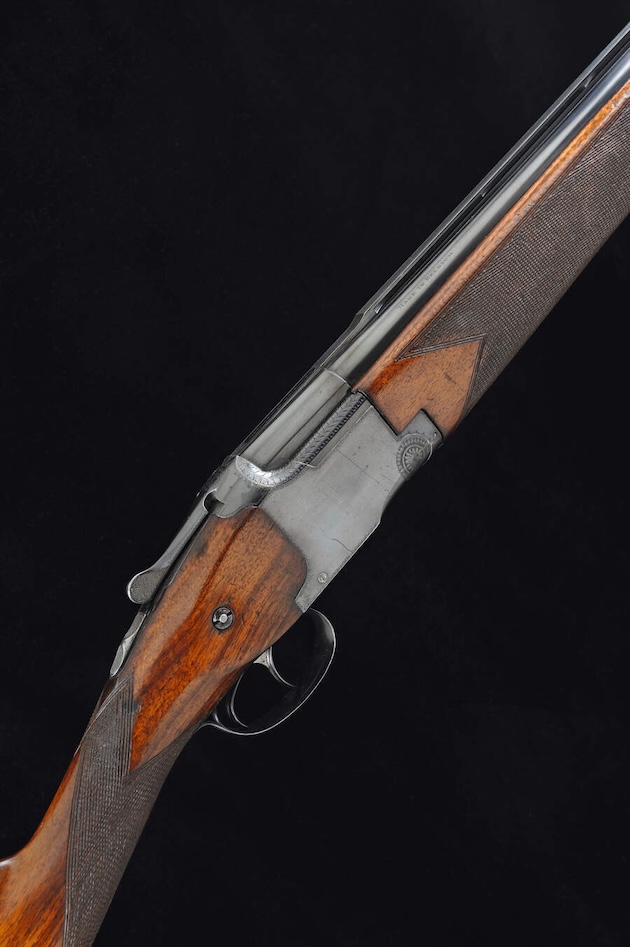
This 12-bore Superposed, No 6, is one of the earliest examples of the classic Browning B25 known to exist
Auto-5 repeater
FN was the primary manufacturer of the Browning Auto-5 shotgun for the Browning Arms Company from its inception in 1902 all the way to 1978 (nearly three million were made). FN also produced the BAR during the First World War. This collaboration between Browning and Fabrique Nationale transformed FN into a global firearms powerhouse. In the 1960s, though, rising labour costs and deteriorating industrial relations in Belgium led much Browning sporting gun manufacture to be outsourced to Japan. Nevertheless, in this complex corporate saga, FN acquired the Browning Arms Company in 1977. It became an asset of FN Herstal, and has been owned by Belgium’s Walloon Region since 1991 (alongside Winchester Repeating Arms – licensed to FN in 1981 and fully acquired in 1989, the brands remaining operationally distinct).
A latest-model Browning B25 Superposed over-and-under with best engraving and finish
Returning to the Superposed, Val Browning developed no less than three single triggers for the B25, all superseded since but notable in their day. There was a nonselective single (useful for guns choked full and full), a selective single (with a selector latch positioned forward of the trigger) and a ‘twin single’. With the last, the front trigger fires bottom barrel first, and the rear trigger top first – so either trigger can be used as a single (later, Lauronas had a similar arrangement as did some Churchill guns). Val Browning also developed his father’s ideas on sighting ribs. Part of John Moses’ original concept was a slightly elevated, subtly stepped rib that would draw the eye to the target. This was later billed as the ‘Non-Crossfire’ rib. A ‘flat hollow’ rib, a ribless gun, ventilated flat and elevated ribs and, much later (1961), a wide-rib model called the Broadway were offered (some of these arriving in Britain have subsequently had the ribs replaced with narrower ones).
A comparison is often made between the Browning Superposed and Beretta over-and-under. The gun that perhaps best warrants comparison, however, is the post-Second World War Model 55, which led to the enduring 68 series trigger-plate guns and the now ubiquitous Silver Pigeon (although the Remington (19)32 – later developed by Kreighoff – and the Perazzi, appearing in the mid-1960s, also deserve note). The Browning has a full-width hinge pin bearing on lumps under the barrel, and a wide locking bolt to the rear meeting a bite beneath the bottom chamber. The Beretta uses a different locking system involving small conical bolt heads meeting bites in the monobloc either side of the chamber mouths, and a hinging system with stud-pin trunnions at the knuckle locating in recesses in a monobloc. As a result, it is shallower. Subsequent Brescian hybrids, such as the Rizzini and Guerini, have taken the efficient Browning rear-bolt arrangement and combined it with Beretta-like stud-pin hinging to the front to reduce action height.
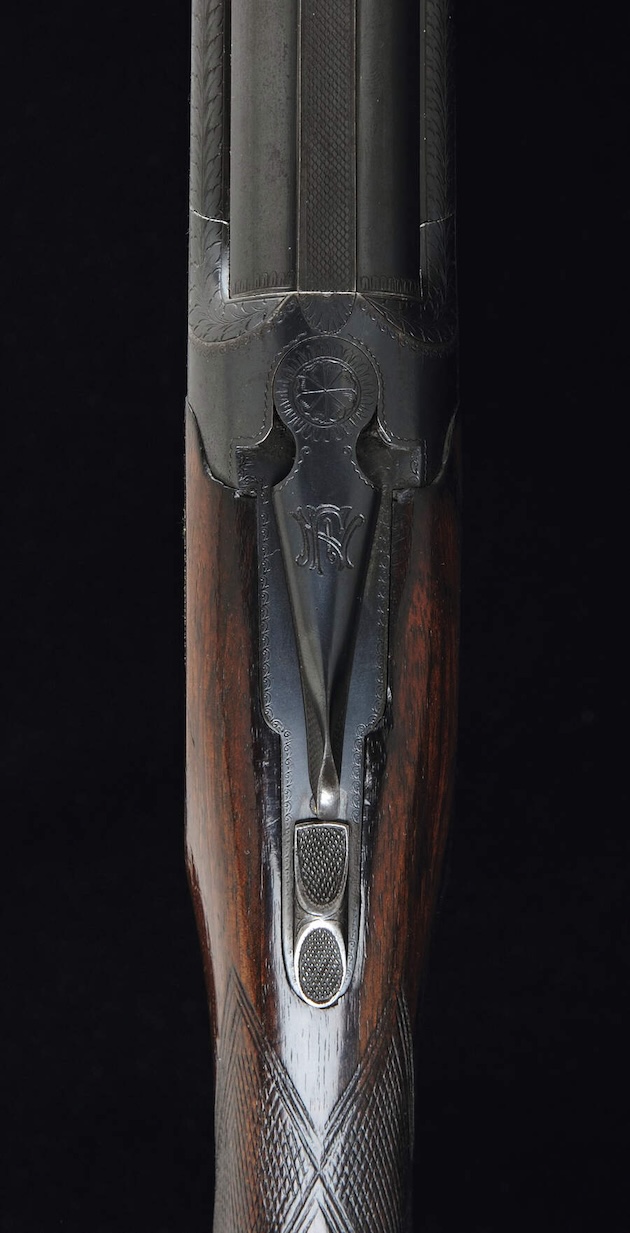
Browning B25 with the older ‘Y’ pattern
Refining the Superposed
Early Superposed guns had action frames that were fairly square-edged rearwards and rounded forwards (raised panels and beaded edges to action bellies were also seen on deluxe guns). The shape changed notably circa 1968-70 when a more symmetrical and marginally lighter pattern was adopted with slight rounding along the bottom edge (the pattern taken from lightweight game models). Single-trigger mechanisms were refined and some glitches eliminated. In 1938 Val Browning had applied for a patent for a (now familiar) tang-mounted barrel selector. This single selective trigger became the standard offering after the Second World War with double triggers (still popular in Europe) a special order. There is also record of a sideplated exhibition gun in 1939. In that year, the UK cost for a by then thoroughly reliable and well-made standard model was £19 10s but a single trigger – selective or nonselective at the customer’s choice – was an £8 extra, as was a ventilated rib (some early guns were produced without any top rib, with stippling and a central sighting line on the barrel top). Standard field model stock dimensions were 14½in for length and 1½in, 2¼in at comb and heel. Barrels of 28in, 30in and 32in were offered as well as highercombed trap and Monte Carlo stocks.
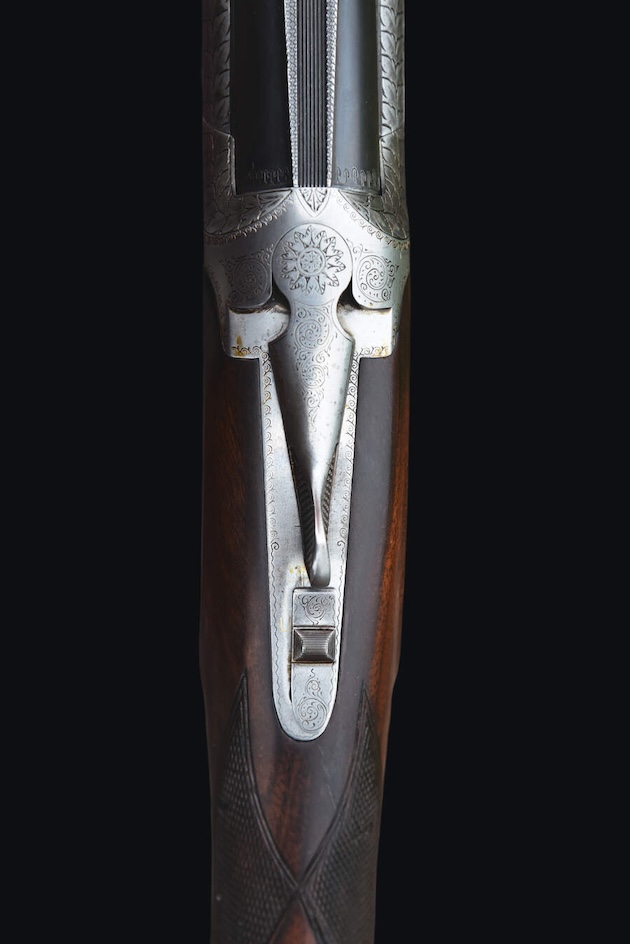
Browning B25s: one with the later, more streamlined ‘U’-type top tang, seen from the mid-1960s
A 20-bore version was introduced in 1949 and the 28-bore and .410 arrived in 1959. In later years Browning experimented with stock forms and finish, and changed barrel fore-end channel and wall thickness. Magnum chambers became available in the mid-1950s for 12-bores. The ‘swan neck’ became an option in the mid-1960s and a tulip fore-end was also offered on European lightweight game guns. Around 1966, the form of the top tang was also changed from the older ‘Y’ pattern to the more streamlined ‘U’ type. Many early guns – pre 1939 – had straighthand or semi-pistol grips, with the full pistol becoming popular following the Second World War. The Browning pattern has rarely been bettered: even in depth, it offers good purchase top to bottom, with the hand especially well anchored.
The ejector mechanism was slightly simplified in the mid-1960s as well. Trigger-guard tangs were shortened for the US market. The retaining screw for the attached fore-end was removed from its side to under the fore-end iron slider in the action belly. Sideplated and bespoke guns became more featured from 1970 as sales for B25s declined. From 1984 it became a custom-order gun. A limited number of artisan-made guns are still produced in Herstal, keeping skills alive. Prices start around £25,000. Highly engraved, sideplated, extra-finish pieces can approach £100,000.
When the Japanese began copying the B25 in the 1950s, the first reaction by Browning and FN must have been irritation. But developed copies were so good that, eventually, Browning America – which had only moderate success with Belgian FN-made or finished B26 Liege and B27 economy models – saw opportunity and, as legend has it, despatched a delegation to the land of the rising gun (one report has Val Browning going there in 1965). This resulted in a new line of B25- style Citori guns with BC Miroku (a firm that had already made the single-barrel BT-99 trap gun for Browning since 1968). The Browning Citoris, 325, 425 and now 525s and 625s (US), became a great success (before this era Miroku was marketed under the Charles Daly brand in the US).
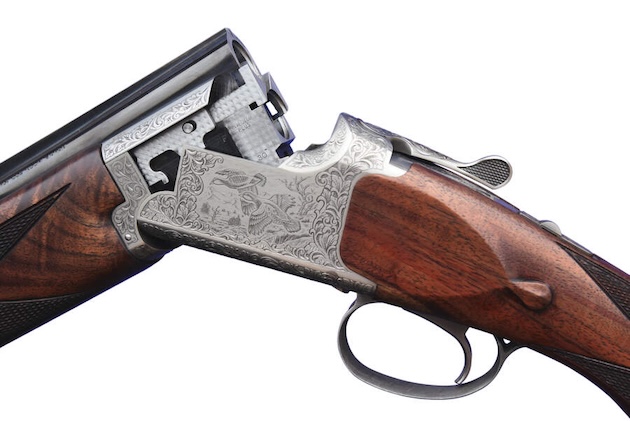
Miroku shotguns use a slightly simplified version of the B25 design
The B25 has gone through significant evolution. Single triggers have evolved: they are now generally mechanical (with an inertia element) in B25s, 725s and 825s and inertia in the 525 range. There have been slight changes to ejector work. But, overall, the gun – especially the one coming from Herstal – is remarkably similar to the original. The most interesting change is seen in the derivative guns made in Japan. Nearly all Japanese Browning and Mirokus have a detachable fore-end (the exception is the hybrid 125), unlike the B25 where the fore-end stays attached to the barrels on basic disassembly. There is no keyway in the action belly to accommodate a slider. Barrels remain demi-lump in the true B25 with tin-soldered ribs (Japanese guns have silver-soldered/brazed ribs). Monobloc construction was introduced into the Miroku-made guns mid-way through the B425 production. There has also been much development of choke systems. Alloy-actioned, lightweight models have been brought in too (but an alloy-actioned B25 has not yet come to light).
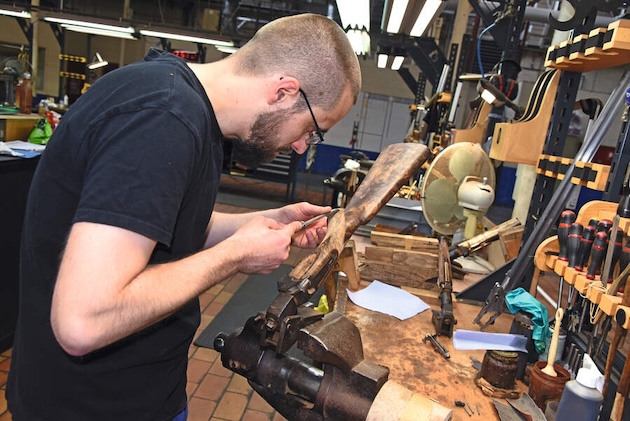
A stocker at work at the John M Browning collection workshop
Newer models
The recent 725 (2012), B15 (2015) and 825 (2025) warrant further mention. They are a clever reworking of the B25 to reduce action height without changing the fundamental mechanism (they retain a full-width hinge pin and similar locking). The sideplated B15, like the old 125, involves a kit of 725-like parts being sent ‘in the white’ from Japan to Herstal. These newer models all have a mechanical trigger and, in multichoked guns, DS (Double Seal) chokes with a copper band to the rear to improve the seal between barrel wall and choke tube. Barrels are hard chrome internally. The impressive new 825 further refines the excellent 725. Its action fences have been remodelled, the top-lever slimmed and elongated, and the trigger function improved for lighter loads. There are changes to stock form and handling too.
No other sporting shotgun has been more influential or spawned as many copies. What is truly remarkable, though, is that the gun as originally conceived, and which is still being made in small numbers in its original form, remains the equal or better of many more modern creations. The Superposed is still super.