



Sir Roger Scruton’s passion for following hounds profoundly influenced his writings on rural matters and the connection between people and the land, writes Colin Brazier
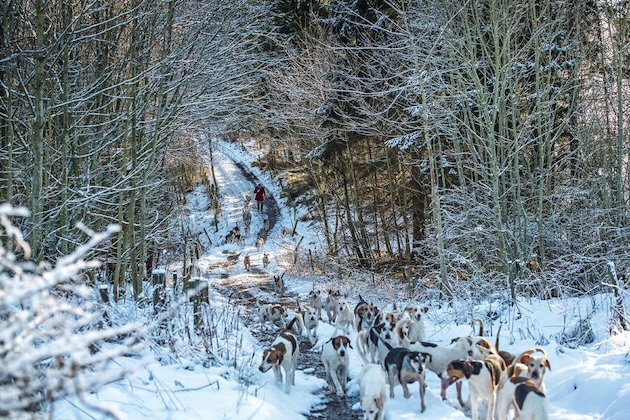
It was at Labour’s annual party conference a quarter of a century ago that the mask slipped. With an election looming, Tony Blair was again pledging to ban foxhunting. The Prime Minister, wary of needlessly offending rural voters, was judicious in the words he chose. But his deputy, the late John Prescott, was less careful: “Every time I see the Countryside Alliance’s contorted faces I redouble my determination to abolish foxhunting,” he said. After the ban, which Blair came to regret, Prescott rarely squandered an opportunity to caricature those who hunt as stupid and vicious. They were variously, he wrote, ‘ruddy-faced toffee-nosed twits’ and ‘brainless toffs’.
Prescott’s prejudice was commonplace. To hunt was, according to urban myth, not just cruel but an act of vaulting stupidity. City folk found it incomprehensible that anyone should enjoy hunting, so its practitioners must therefore be uncomprehending. Those who did were devil-may-care dunces drawn from the same cloth as the fictional John Jorrocks, whose inability to string a grammatical sentence together was immortalised in his most famous mangled maxim: ‘The ’oss loves the ’ound, and I loves both.’
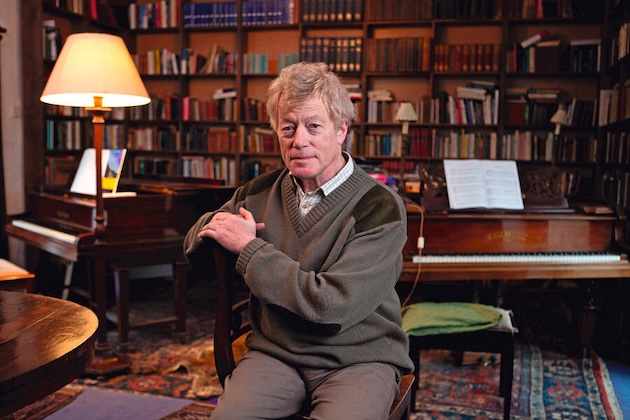
Sir Roger Scruton, whose paean to hunting changed hearts, minds and lives
Beauty and simplicity
But, just as not every Labour MP backed the ban, so very few hunting people fit the stereotype. One backbencher, the then Labour MP for Vauxhall Kate Hoey, even went on to become chair of the Countryside Alliance. She was greatly influenced by the writings of Sir Roger Scruton, who later in life rode to hounds: an epiphany that formed the basis of his book On Hunting.
Baroness Hoey, as she is now, admits that Scruton’s book amounted to a revelation: “It resonated with me as I thought he captured the beauty and simplicity of country life, which is so difficult to explain to those not brought up there.” Hoey bought half a dozen copies of On Hunting for fellow parliamentarians. “It was my attempt to try to make MPs realise that those who hunt love and respect animals, and also to get Labour MPs, in particular, to understand that hunting had been undertaken by miners and men and women from all walks of life,” she says.
Scruton’s paean to hunting is a slim volume, with an impact out of all proportion to its 161 pages. Those Labour MPs may not have been persuaded by his book but other readers were. I am one of them. It is no exaggeration to say it changed my life. I was 44 when I read On Hunting, struggling with the burdens of six young children, a stressful job in television and a wife who was dying of cancer. In the years that followed I regularly returned to it but nothing could quite recapture the shock of picking it up for the first time.
Galvanising effect
It’s a strange mix of the pretentious and pastoral, the lyrical and confessional. Part biography, part meditation on what it is to really live life to the full; and, in part, a call to arms. Its effect on me was galvanising. I vowed not just to learn to ride (I had been on horseback a handful of times) but to ride to follow hounds. I bought a retired steeplechaser and never looked back. Years later I bumped into Tara Douglas-Home who told me that it was while Scruton was hacking his pony, Dumbo, when the local hunt streamed by (taking Dumbo with it) that injected the ageing philosopher with an insatiable love for the sport.
Anyone who has neglected to develop a good ‘seat’ in childhood is always likely to be playing catch-up, and both Scruton and I broke ribs falling off as novice riders. I gave up after my wife’s early death but Sir Roger rode into his seventies, on one occasion sliding off an icy bridge and into a river, breaking his femur. What made Scruton’s equestrian courage all the more remarkable was the contrast it presented with his otherwise sedentary occupation. He wrote more than 50 books, on subjects as varied as wine, sex and opera, terrorism, architecture and poetry. But so deeply did the fishhooks of hunting stick their barbs into Scruton’s flesh that, even when he was lecturing full-time in the US, he would fly home every weekend just to hunt.
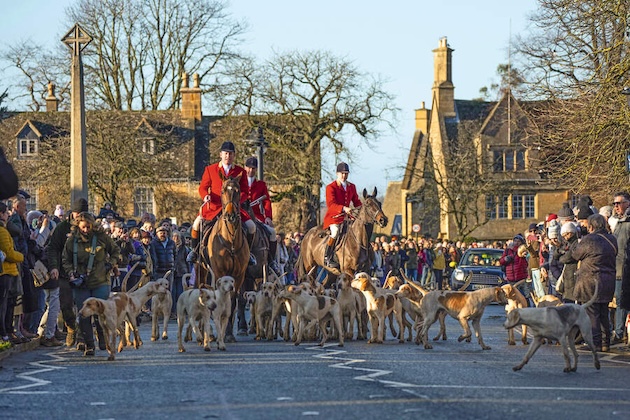
The Boxing Day Meet is one of the countryside’s most cherished traditions
The eulogies produced by his death from cancer in 2020 were telling in the diversity of voices raised in praise. The Nobel Prize-winning author Mario Vargas Llosa described Scruton as one of the most educated men he had ever met. Boris Johnson, then Prime Minister, called him the greatest modern conservative thinker of the age. But encomiums also came from unexpected quarters. I recall being struck by a series of positive tweets posted about Scruton from the account of Amol Rajan of BBC Radio Four fame: a broadcast outlet not known for its conservative leanings.
His funeral at Malmesbury Abbey was attended by the controversial Hungarian prime minister Viktor Orbán; a reminder that Scruton’s underground network running samizdat texts behind the Iron Curtain was not forgotten. His detestation of communism was not a pose. In the 1980s Scruton was roughed-up by secret police and expelled from Czechoslovakia.
I met him only once, at a dinner given by the Hungarian ambassador to mark his knighthood in 2016. He was not a clubbable or frivolous man and did not suffer fools. He spoke about his Damascene conversion in 1968 when, as a Cambridge student in Paris, he witnessed the rioting that set him against socialism forever.
Asked what conservatives should chant if they ever joined a protest march, he half-raised a limp fist and whispered “Hesitate”. He felt Britain was in the grip of a ‘culture of repudiation’, which rejoiced in tearing down our history and traditions, especially in the countryside, regardless of whether they still had a valid purpose.
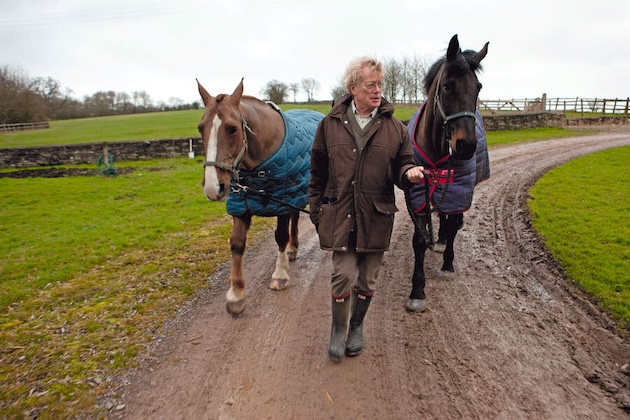
At his home at Sundey Hill Farm in Wiltshire in 2011
Rural writing
And that was the essence of Scruton’s intellectual conservatism. In his early years he took aim at those who had grabbed the commanding heights of academia and elsewhere in their slow march through the institutions. But from the moment in the 1990s when he moved to Sundey Hill Farm in Wiltshire, his prodigious output tended towards rural matters. He was not alone in this. In recent years ‘nature writing’ has boomed. From Jamie Blackett and James Rebanks to John Lewis-Stempel and Robert Macfarlane, there is a growing appetite from smart readers for intelligent books about the countryside. We are blessed with authors with an aptitude for the felicitous phrase to describe the rural world but could any of them do better than these, the opening words of On Hunting?
‘My life divides into three parts. In the first I was wretched; in the second ill at ease; in the third hunting. Most hunting people are brought up in the sport, and shaped by it into a kind of intermediate species, an ancient synthesis of horse, hound and human. Even now I have the sense of hovering on the periphery of the rite, a fascinated spectator of something which has come into being like a language, to be passed down the generations and absorbed from birth, and which can be learned in later life only at the cost of speaking with a foreign accent.’
Talking to hunting folk, I am regularly surprised at the number who had read On Hunting. But for me and many more, Scruton is not just the awkward professor who gave hunting intellectual ballast (of sufficient weight to persuade one former head of the League Against Cruel Sports to abandon his opposition); he is more than that. As Dr Daniel Pitt, co-author of Intellectual Conservatism From Burke to Scruton, says, Scruton ought to be read as the ‘great thinker’ of the British countryside: “He understood that the countryside is shaped by the people who work, live and hunt within it: those who have a connection to the land and an understanding of local ecosystems and cultures. The problems of the countryside won’t be solved by some bureaucrat imposing a top-down, standardised solution based upon abstract, universal solutions imposed by international bodies or governments that are situated nowhere in particular, but by those who have local knowledge and who are embedded in the culture.”
That idea of ‘somewhere’, of being hefted to a place, came to be integral to Scruton’s visions of the countryside. In books such as Animal Rights and Wrongs (1996) and England: An Elegy (2000) he had brought a razor-like intellect to bear on the woes of rural living. But it was News from Somewhere (2004), a book subtitled ‘On Settling‘ and written after he had married and bought his farm, that crystallised his philosophy of the countryside. Central to it was the idea – borrowed from the ancient Greeks – of ‘oikophilia’: the love of home. For Scruton there was something sacred about finding a slice of England, a terroir, a place of rootedness and quiet that defies ‘the motor-mania of the highway and the self-engendered haste of the town’.
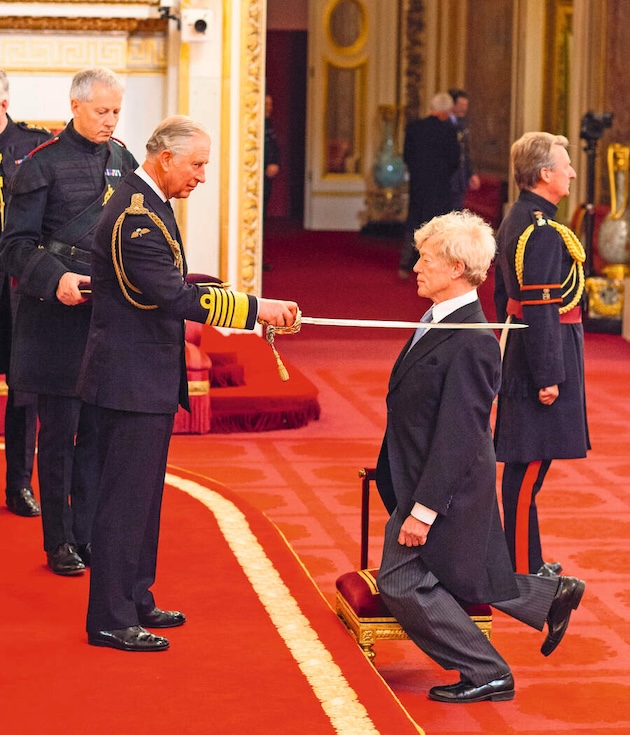
Receiving a knighthood in 2016
Lyrical alchemy
If Clarkson’s Farm brought the gritty reality of life on the land to the masses, Scruton brought it to the intelligentsia. In News from Somewhere he wrote: ‘The desire to settle on a farm is not just a piece of modern nostalgia. For although it is true that, under the escalating pressure of urban life, people have increasingly sought to escape to green pastures and have painted those pastures in the imaginary colours of Eden, the sense that we are at home on the farm is a human universal.’
Scruton could take a subject like light pollution or agricultural subsidies and submit them to a kind of lyrical alchemy. But he was not just about purple prose. Scruton was a trained philosopher. He penned a successful book about Kant, and wrote extensively about Hegel and Wittgenstein. When he took his pen to a topic, he did so with the methods of philosophical inquiry, always starting with first principles. It did not, as noted in Green Philosophy (2012), always endear him to environmentalists ‘for the simple reason that its conclusions emerge at the end of the argument, and are not buried in the beginning’.
The great conservative philosopher Edmund Burke loomed large in Scruton’s mind. Burke memorably said that society was a contract between the living, the dead and the unborn. Scruton understood that this historical continuum meant more in the countryside than it did in the everchanging city. And Burke’s ‘little platoons’, the small voluntary bodies that are the lifeblood of civil society, were part of what Scruton saw as the eternal verities of country lore. He told a story about the children of Romanian resistance fighters who he and his wife had not just taken in but taken to Pony Club summer camp: ‘The Pony Club has fully acclimatised them to England; they understand the reticence, the formality, the uncompromising tolerance and the need to be tough; most of all they understand and identify with the resolute independence of spirit that has been destroyed in their homeland but which still lives around here.’
Famously, the Brits do not do philosophy. For the French and Germans, philosophers like Nietzsche or Sartre were intellectual rock stars, even household names. Scruton did not have that kind of popularity but he had something his Continental counterparts often lacked: a sense of humour. Take this, from News from Somewhere:
‘…the moment in October when the fields refuse to absorb more rain and the cows begin to churn up the pasture. It is the moment when the animals take their revenge, remaking the landscape as a warm bath, friendly to four-legged creatures, hostile to man. The faces of the horses, as they watch you slither towards them, express their sudden bliss: “four legs good, two legs bad”, and a laugh of triumph sounds somewhere under the hillside.’
Like Scruton, I also took to late-life livestock husbandry, keeping sheep and pigs in Wiltshire. His philosophy helped teach me the rhythms of the countryside and find the transcendent joy – a joy like no other – that comes from riding a horse at full gallop over uncertain ground.
Colin Brazier is assistant editor of The Salisbury Review, the quarterly journal of conservative thought, founded by Sir Roger Scruton.