




Testing two Fabarm side-by-side shotguns with similarities but radically different specifications makes for an intriguing exercise, as Michael Yardley discovers
Two Fabarm side-by-side shotguns

I’ve taken a look at two Fabarm side-by-sides imported by Anglo Italian Arms. Both are built on rounded-bar, forgedsteel- frame, trigger-plate actions that are mechanically alike. The guns have similarities in stocking and boring, too, but beyond that their specifications are quite different. One, the 12-bore Infinite RS, is a heavyweight – 8lb 11oz – clay gun (with a possible application for high birding). It features a ramped high rib and adjustable comb. The other gun, the Autumn Elite 20-bore (also available in 12-bore and as the plainer but elegant Autumn), is an extra-finish field model weighing 6lb 11oz with 28in barrels (30in is an option). Gold gamebird inlays adorn its silver-finished and laser-scroll-engraved action. (Read: the enduring appeal of the side-by-side shotgun.)
Aesthetically, both guns succeed. The Infinite RS looks much like one of the firm’s over-and-under competition models reconfigured as a side-by-side. Its satin black action is smart, with the RS infinity logo and blue line detailing on the fences the only embellishment. Moving on to the stock, the oil-finished wood (Turkish walnut) is pleasantly figured and boasts large but ergonomically efficient gripping shapes, including a right-hand palm swell. Full but comfortable, the Monte Carlo comb may be adjusted by means of Allen screws on the right side of the butt.
The Autumn Elite has bolder decoration but equally efficient yet proportionately smaller stock shapes (no palm swell). Its heel measurement is a little low at 2⅜in and it would benefit from more bump at heel.
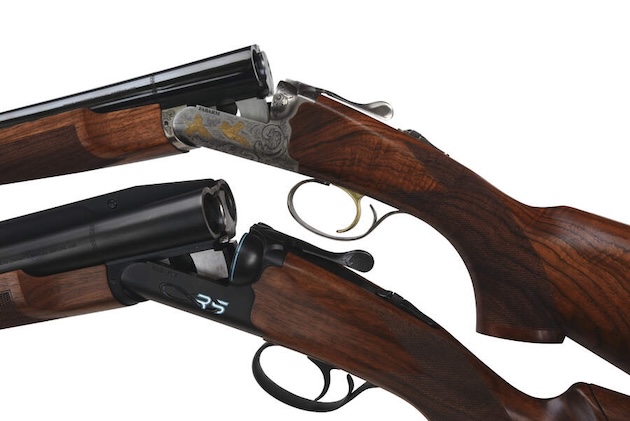
The Autumn Elite is boldly decorated compared
with the Infinite RS (bottom)
Balance
Fabarm has brought the balance of its guns rearward to just in front of the knuckle to make them more lively: a sensible move. The 32in RS behemoth is surprisingly willing to move. Although very different in terms of weight and barrel length, the two guns do seem quite similar between the hands – definitely members of the same family. What about the weight? Even the 20-bore is on the heavier side by traditional measure. Nevertheless, touching on 6¾lb works well with this efficiently stocked 28in gun. The London best 28in 12-bore was often made around this weight in its golden age. A weight of 7lb would be typical for a best 12-bore circa 1900, then 6½lb to 6¾lb became the norm before a craze for even lighter guns struck and was sometimes taken to extremes. Barrels of 28in help this model stay significantly under 7lb but still feel steady. If machine-made side-bysides have a disadvantage, it can be heavy barrels – potentially mitigated by 28in tubes without losing significant pointability (at least in game guns).
Advantageous weight
What about the Infinite RS? This certainly feels a big beast but it may appeal to some for precisely this reason. It is most unusual in regard to both its overall weight and all the features it offers – not just the high rib and adjustable comb but taper boring and ‘hyperbolic’ steel-shot-friendly chokes (shared with the Autumn Elite and other Fabarm side-by-sides). There really is nothing else like these Fabarms. Is 8lb 11oz too heavy? For some it will be: you wouldn’t take the gun woodcock or snipe shooting. But for the man with well-toned muscles who uses an 8½lb or 9lb competition over-and-under, the weight may be seen as advantageous.
Modern shots sometimes complain that side-by-sides are too light. They forget that these guns have always been made in a wide variety of weights as discussed. Game guns are more commonly encountered today. However, American companies such as Fox used to produce excellent super-heavy (9lb) guns for longrange wildfowling. Similarly here, old 3in-chambered guns were often made around 8lb in 12-bore, and 7½lb pigeon guns are commonplace (and still favoured for clay shooting). This Infinite RS will find its niche.
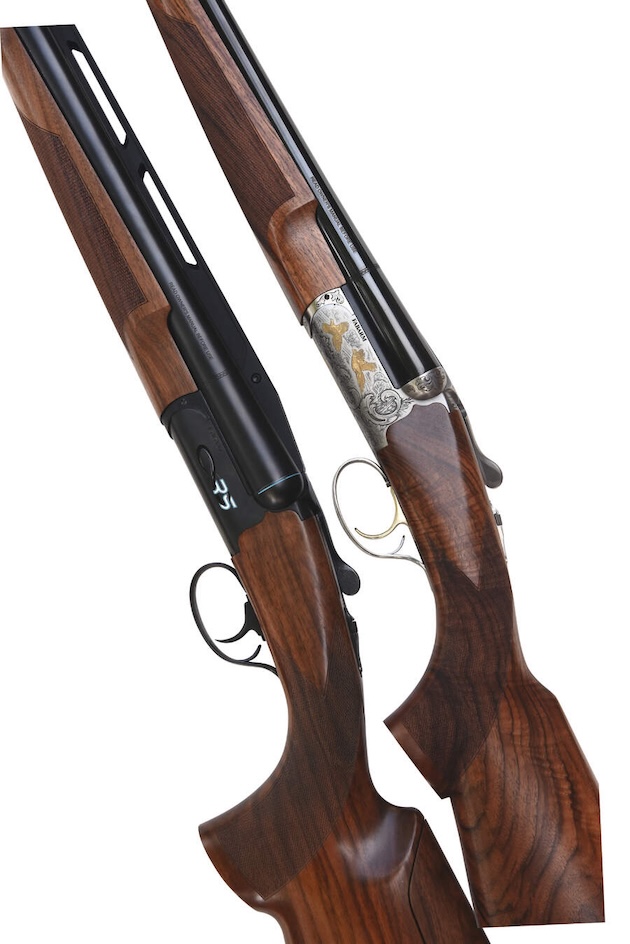
Similar in action and boring, the guns were otherwise very different
Technical
Most side-by-sides are built on the Anson & Deeley boxlock or Holland & Holland sidelock plan using double lumps developed by Purdey. The Fabarm, a trigger-plate design, dares to be different with four lumps meeting slots in a relatively compact action body. Lock-up is achieved by a single flat bolt to the rear emerging from the action face. It’s a well-proven arrangement. The guns have a near-horizontal stock bolt rather than a vertical breech pin to secure the butt to the action. With regard to barrel construction, Fabarm side-by-sides are monobloc, as are most mass-produced over-andunders. Barrels are deep drilled not cold hammer forged and, since 2005, ‘Tribored’ with long forcing cones, back-boring and a taper-bored forward section. Fabarm Hyperbolic chokes have a curved internal profile that allows for the use of steel shot in all constrictions. They are proofed to 1,630 bar.
Shooting impressions
It was interesting to compare guns of such different specifications. The 32in, 8lb 11oz Infinite RS with extended chokes was the heaviest and longest side-by-side yet tested here. Although a behemoth, it has good stock shapes with a comfortable, large, palm-swell grip and beavertail fore-end. It felt much like a modern over-and-under competition gun. With its unusual elevated, double-beaded rib it shot precisely and moved surprisingly well. Both rib and gun grew on me. Recoil was minimal with Lyalvale 24g No 71/2s. Stock shapes offered exceptional purchase, aiding with the weight. The 28in 20-bore Autumn Elite was 2lb lighter and also had great stock shapes as noted and a particularly comfortable, slimmed, beavertail fore-end and terrific mid-radius grip (sans palm swell). I would have preferred a flat rib to the concave one present but it would be hard to improve on the stock form. The gun was especially steady to shoot.
Fabarm Infinite RS and Autumn Elite side-by-sides
RRP: RS Infinite 12-bore £3,995
Autumn Elite 20-bore £3,895